
Identifying winter trees? I often have difficulty identifying them in summer! It would appear that I’m not the only one, either, because several members of our WWP group came out in today’s modestly below-freezing temperatures and had an enjoyable and instructive walk with John Sly, one of Buffalo Audubon Society’s team of knowledgeable volunteers. Indeed, John was able to pass on so much information that it was a challenge to keep up.


Beaver Meadow Arboretum
Deciduous twigs opposite or alternate? If opposite each other then “MAD Horses” are responsible! (Maple, Ash, Dogwood or Horse Chestnut – a great acronym that should prove easy to remember.)
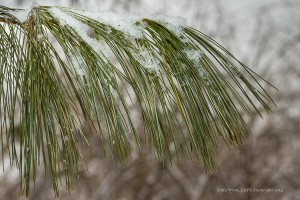
White Pine
Compound leaves or simple? Well yes, this was a question about summer trees, not winter, but as we were apparently not willing to leave any leaf unturned, the questions were still answered.
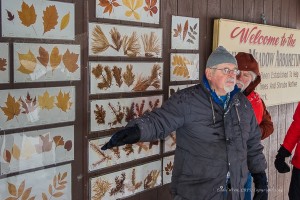
Display of leaves at the Arboretum
Pines with needles in bundles? If in twos, it could be Red Pine or Jack Pine (though they are very different) but if the needles are in fives it is the remarkable Eastern White Pine – a tree whose timber caused ructions inthe build up to the Revolutionary War.
This wasn’t all, of course. There were still bark, buds and seeds to consider, not to mention the habitats in which each species found its favoured niche.
Prior to starting the walk, we had the opportunity to briefly look at at John’s own display collection of over 80 species of leaves, together with various seeds, pine cones, twigs and so on. Interestingly, when I asked him, he added that the leaves would keep their green colouration and remain usable for display for about 15 years.
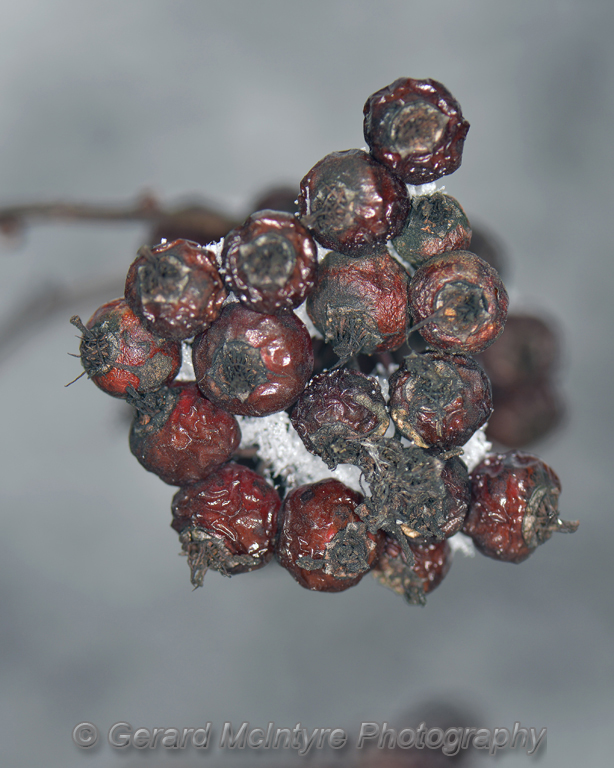

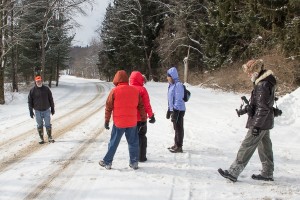
Gerry, balancing flash exposure with background snow
Key little tidbits came out during this ‘classroom’ session, such as the indentations in some maple leaves being ‘U’ shaped, which indicated sUgar maple, and others being V shaped. John also passed around several of his older tree-identification books — mostly just printed with monochrome illustrations, unlike today’s brightly-coloured volumes — but showed us the detail in the typically larger illustrations, an aspect which spoke for itself.
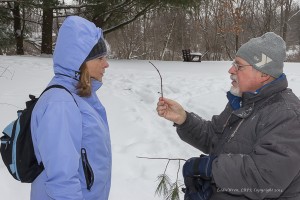
Detailed explanations
During the first two-thirds of our walk, snow fell quite heavily, and this meant that those of us with DSLR cameras which were not weather-proof had to be cautious about the water getting in. And some of us (meaning me!) had forgotten to to pack our waterproof compact camera, too, so several photo opportunities were lost!
What started out, perhaps, as just a good reason to get outside and have a winter walk, turned out to be extremely interesting and I,
 for one, will look for other opportunities to go out on John’s various guided walks because — to use a well-known phrase — he’s a man who has clearly forgotten more about trees than I will likely ever know. And just to end the walk on a high note, the sun came out and graced us with its presence on our way back to the BAS buildings.
Finally, my thanks to Gerry McIntyre, for sharing some of his photos with us in this blog.
Eddie Wren


