Category Archives: USA (news)

US wildlife news

Links to Wildlife-related Blogs in the Rest of the USA

Back to the main LINKS page

____________________________

INDIVIDUALS

Dragonflies and Damselflies of the N.W. and Beyond (Jim Johnson)

Feathered Photography (Ron Dudley, Utah)

Insect Photography (Alex Wild)

Jerry Liguori’s Raptor Blog

Meadowlands Nature Blog (Jim Wright, NJ)

Ohio Nature Blog (Tom Arbour)

ORGANIZATIONS

Conservancy Talk    Nature Conservancy staff share their voices on everything from the latest conservation issues to living green.
.
Cool Green Science Nature Conservancy science: 550 scientists helping you get smart about nature.
.
Nature Rocks   Aiming to inspire and empower families to play and explore in nature for happier, healthier and smarter kids.

 ______________________________________________

Please feel free to post comments below, with the URLs for other good wildlife blog sites.  (All we ask is that they be posted on the correct page: WNY, USA or Worldwide, please.)

Snowy Owls in Western New York, January 2014

On 26 January, 2014, Gerry Rising had an article published in the Buffalo News in which he wrote that, remarkably, he has received over 100 reports of snowy owls in the Western New York region, this winter.

Snowy Owl. Copyright 2013, Andrea Burke

Snowy Owl. Copyright 2013, Andrea Burke

As one might expect, this hasn’t been a result of all the snowy owls in the arctic agreeing that they wanted to come and see Niagara Falls during their winter vacation, it’s just that far more owls than usual have come south this year and it would appear that everywhere is getting higher numbers of these beautiful visitors than is usually the case.

Snowy Owl. Copyright 2014, Jennifer Grande

Snowy Owl. Copyright 2014, Jennifer Grande

The increased number of owls, this winter, is the result of a periodic surge that happens every few years in the numbers of lemmings in the arctic, and this took place last summer.  It is a simple equation: more lemmings means more young owls getting enough to eat and therefore surviving.  This results in an ‘irruption’ in which the species is seen across a much larger winter migration area than is usually the case.  The downside of such surges in numbers is that in the coming few months, when the owls get back to the arctic, there inevitably will be fewer lemmings and the breeding success of the owls will fall once more, in line with that situation.

Snowy Owl. Copyright 2013, Andrea Burke

Snowy Owl. Copyright 2013, Andrea Burke

In the book Owls of America, by Frances Backhouse, there is a very interesting map showing the typical winter distribution of snowies.  Only two regions in the USA are marked as getting some of the owls every winter.  One of these areas, as keen birders in this area know, is New England and New York.  The second is the Dakotas and Montana region.
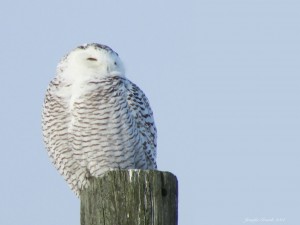
Snowy Owl. Copyright 2014, Jennifer Grande

Snowy Owl. Copyright 2014, Jennifer Grande

By comparison, the breeding distribution – which is also shown on the map – is much more limited than I had anticipated.  For example, only the areas near the north west and north east coasts of Alaska is marked. I had wrongly assumed for example that most, if not all of Alaska would be part of their breeding range, but that is not the case.  Similarly, only the far-northern coastal area of Canada supports breeding, not the entire tundra zone.  Even in Greenland, according to the map – and just like Alaska – only the areas near the north west and north east coasts are in the breeding range.

Snowy Owl. Copyright 2014, Jennifer Grande.

Snowy Owl. Copyright 2014, Jennifer Grande.

Excerpt from ‘Owls of America’:     “Snowy owl numbers fluctuate dramatically.  Reproductive highs and lows [as stated above] are closely tied to lemming population peaks and crashes.  Long-term population trends in North America are not known.  Recent research showing some movement of snowy owls between Alaska and Russia suggests that conservation efforts should be co-ordinated internationally.”

One other interesting thing about snowies is that unlike most other species of owl in the world, males and females have different plumage and can be told apart.  Old males can be almost pure white, whereas females are moderately to heavily barred with black, and juveniles have the darkest markings.

Snowy Owl. Copyright 2013, Andrea Burke

Snowy Owl. Copyright 2013, Andrea Burke

Personally speaking, I have had back problems throughout this winter, and although the precise cause is now known and a cure is in sight, this has meant that I have been immobile and have not been able to go and see the owls.  I believe the appropriate, exasperated expression is: “Grrrrr!”

The reason I have posted this article is to accompany photographs taken during the past few weeks by members of our Wildlife Watchers and Photographers (WNY) group.  I hope you all enjoy the pictures as much as I have.  (And any members who have not yet submitted photos of “their” snowies, please do so and I will add them to a gallery on this page.)

Eddie Wren

___________________________________________

 Anyone in the Western New York region who is interested in joining the Wildlife Watchers and Photographers (WNY) group, please e-mail the owner of this blog and introduce yourself.

___________________________________________


Keywords: snowy owl, Bubo scandiacus, Andrea Burke, Jennifer Grande, Eddie Wren, Western New York, WNY, birds, Buffalo News, Gerry Rising, Frances Backhouse, Owls of America, migration, plumage, range, winter, arctic, lemmings, birding, wildlife, nature, USA


U.S. ‘Great Backyard Bird Count’ [GBBC] – February 14-17, 2014

This international event engages bird watchers of all ages in counting birds to create a real-time snapshot of where the birds are across the continent. Participants tally the number of individual birds of each species they see during their count period. You can count for as long as you like each day of the event, then enter your count numbers on the GBBC website. To learn more about the Great Backyard Bird Count and how you can participate, see their website at www.birdsource.org/gbbc

In addition, at 7:00pm on Thursday, February 13, 2014, there will be a training session (either by conference call or an online webinar) for people to learn how to participate in the GBBC and how to record the bird  data.  There will also be some discussion about bird identification. Please sign in early for the online  webinar as you will have to download some software on your computer in order to participate.

To listen to the Conference Call dial Toll Number:  213-416-1560  — Attendee Access Code: 923 4565

To join the webinar online, copy and paste the following URL into your browser:    https://www.anymeeting.com/697-349-863?rslt=a37f0cda-6fd4-40a7-b051-89e30ce5e366


Excellent U.S. nature books by Bernd Heinrich

I’m delighted to now have three of Prof. Heinrich’s books and I will certainly continue to collect and absorb them.

Book_Heinrich_Year-in-Maine-WoodsPerhaps his best known book is  ‘A Year in the Maine Woods‘ and it was the first one I bought.  In it, Bernd Heinrich effectively took a full year to study the wildlife of the area in which he grew up, and the result is fascinating.

The Washington Post wrote of this book: “[It] is quirky, unassuming, humorous, enlightening, and just a little bizarre.  If you’re a stranger to Heinrich, it’s an ideal time to make his acquaintance.”

I also have what I think of as a ‘matching pair’ of Heinrich’s books, namely:

Book_Heinrich_Summer-World‘Summer World – a season of bounty‘, and ‘Winter World – the ingenuity of animal survival‘, the latter of which I just finished reading yesterday.

This is a duet to fascinate any naturalist and gives insights of the natural world that I, for one, had never even thought of before, let alone understood.

So what will be the next book in this series that I’ll get?  Hmmm, I’m not too sure just yet because there are several that I want.  High on the list are:

  • The Trees in My Forest
  • Life Everlasting: The Animal Way of Death
  • In a Patch of Fireweed: A Biologist’s Life in the Field
  • The Thermal Warriors: Strategies of Insect Survival
  • The Homing Instinct: Meaning and Mystery in Animal Migration
  • The Nesting Season: Cuckoos, Cuckolds, and the Invention of Monogamy

….and there are several more titles that I haven’t even listed.

Eddie Wren


[Bernd Heinrich, Ph.D, is a professor emeritus in the biology department at the University of Vermont and is the author of a number of books about nature writing, behavior, biology, ecology, and evolution.  Heinrich has made major contributions to the study of insect physiology and behavior, as well as bird behavior. In addition to other publications, Heinrich has written eighteen books, mostly related to his research examining the physiological and behavioral adaptations of other animals to their physical environments. However, he has also written books that include more of his personal reflections on natureWikipedia]

_______________________________________________________________________

See also ‘The Forest Unseen’, by David George Haskell


Book: ‘The Forest Unseen’ by David George Haskell

This book is extraordinary… outstanding… superb!                                       (I think you might have got the drift of my opinion by now!)

The Forest Unseen

The Forest Unseen

David Haskell is a professor of biology at the University of the South, but just in case that makes people think his writing may be stiff & starchy, or perhaps overly-technical, this is what James Gorman of the New York Times wrote about the Forest Unseen: “[Haskell] thinks like a biologist, writes like a poet, and gives the natural world the kind of open-minded attention one expects from a Zen monk rather than a hypothesis-driven scientist.” …. And I couldn’t agree more, even though I’ve never actually met any Zen monks!

On page 238, Prof. Haskell himself writes:

        ” Scientific models and metaphors of machines are helpful but limited.  They cannot tell us all that we need to know.  What lies beyond the theories we impose on nature?  This year, I have tried to put down the scientific tools and to listen:  to come to nature without a hypothesis, without a scheme for data extraction, without a lesson plan to convey answers to students, without machines and probes.  I have glimpsed how rich science is but simultaneously how limited in scope and in spirit.  It is unfortunate that the practice of listening generally has no place in the formal training of scientists.  In this absence science needlessly fails.  We are poorer for this, and possibly more hurtful.  What Christmas Eve gifts might a listening culture give its forests?

         “What was the insight that brushed past me as squirrels basked?  It was not to turn away from science.  My experience of animals is richer for knowing their stories, and science is a powerful way to deepen this understanding.  Rather, I realized that all stories are partly wrapped in fiction — the fiction of simplifying assumptions, of cultural myopia and of storytellers’ pride.  I learned to revel in the stories but not to mistake them for the bright, ineffable nature of the world.”

And the price of this immensely enjoyable work of genius — a book that any nature lover can easily read — is $16; not bad for a masterpiece!  I kid you not when I say that now that I know what’s in Forest Unseen, I would happily have paid $100 for it.

 Eddie Wren

See also the excellent books by Bernd Heinrich

_______________________________________________________________


US experiences largest influx of snowy owls in decades (video)

Feb. 04, 2014 – 2:11 – Huge number of birds fly south from the Arctic

Winter on Cape Cod is a solitary time. The beaches are empty and the summer tourists a memory, but this year visitors from the far north are drawing quite a crowd.

Snowy owls have flown down from the arctic tundra, spotted as far south as Florida and many more are being seen in the Northeast. Experts say it’s the largest migration of snowy owls to the United States in decades….

Read the full article and view a two-minute video from Cape Cod, at: http://www.foxnews.com/science/2014/02/04/massive-migration-snowy-owls-breaks-record/


See also:  Snowy Owls in Western New York, January 2014

AMERICAN OYSTERCATCHER POPULATIONS REBOUND | The Nature Conservancy

Five years after conservation groups launched a large-scale, coordinated effort to recover the imperiled American Oystercatcher, the species’ population has stabilized and begun to increase, according to an aerial survey conducted in 2013.

ARLINGTON, VA | January 28, 2014

Ten years ago, the charismatic, orange-billed shorebird was threatened by habitat loss and human encroachment. A comprehensive survey that year showed about 10,900 total birds and a rapidly declining population. The numbers kept dropping until 2009, when a coalition of 35 groups from Canada to Texas mobilized to protect the species. A survey completed in 2013 found about 11,200 birds. The coalition includes The Nature Conservancy, the U.S. Fish and Wildlife Service, the Virginia Department of Game and Inland Fisheries and the College of William and Mary.”This kind of conservation success is extraordinary, especially in the shorebird world,” said Shiloh Schulte, a scientist at the Manomet Center and coordinator of the American Oystercatcher Working Group. “This was a targeted and coordinated approach to conservation involving 35 organizations, federal, state and private. We were hoping to see some signs of recovery with this survey, but the results show the population has already exceeded the 2003 mark.” The aerial survey covered more than 9,000 miles of barrier islands and salt marshes from Long Island to the Mexico border and the results were officially announced last month at the annual American Oystercatcher Working Group meeting in Wrightsville Beach, North Carolina. “In Virginia we have seen a 9 percent increase in the number of breeding pairs on the state’s barrier islands since 2009 as the result of increased oystercatcher conservation efforts,” said Alexandra Wilke, a shorebird biologist with The Nature Conservancy in Virginia. “Thanks to the support, guidance and leverage of the Working Group and partnership with both the Virginia Department of Game and Inland Fisheries and the U.S. Fish and Wildlife Service, we have successfully acquired two National Fish and Wildlife Foundation grants over the past five years. These grants have helped support these efforts in coastal Virginia, such as increased stewardship activities and habitat management for oystercatchers and other beach nesting shorebirds.”The coalition includes Audubon Connecticut, Audubon Louisiana, Audubon North Carolina, BiodiversityWorks, Canadian Wildlife Service, City University of New York, Clemson University, College of William and Mary, Conserve Wildlife Foundation of New Jersey, Delaware Division of Fish and Wildlife, Florida Fish and Wildlife Conservation Commission, Georgia Department of Natural Resources, Gulf Coast Bird Observatory, Manomet Center for Conservation Sciences, Maryland Department of Natural Resources, Massachusetts Audubon, Nantucket Conservation Foundation, National Audubon Society, National Park Service, New Jersey Audubon, New Jersey Division of Fish and Wildlife, New York City Audubon, North Carolina State University, North Carolina Wildlife Resources Commission, Rutgers University, South Carolina DNR, Texas A&M University, The Nature Conservancy, Trent University, University of Georgia, U.S. Fish and Wildlife Service, Virginia Department of Game and Inland Fisheries, Wildlife Conservation Society, U.S. Geological Survey and the National Fish and Wildlife Foundation.

via AMERICAN OYSTERCATCHER POPULATIONS REBOUND | The Nature Conservancy.