Category Archives: Life

Living creatures, plants and fungi

A Couple of Gems at Tifft Yesterday

After recently shaking off the tedium of a bad back that I’ve suffered virtually right through the winter, I took advantage of a few free hours yesterday to have a walk around the Tifft urban nature preserve.

Canada Goose in flight

Canada Goose in flight

When I arrived, at 8:00am, the temperature was just 18F (minus 8 Celsius) and there were no other cars in the parking lot.  On the small patches of open water, at Lake Kirsty, adjacent to the preserve offices, were four Herring Gulls, a solitary male Red-breasted Merganser, a pair of Hooded Mergansers and a dozen Canada Geese.

Black-capped Chickadee foraging

Black-capped Chickadee foraging

Anyway, wrapped up like the Michelin man, I set off through the woods on my way to the South Viewing Blind (hide) to look at a frozen lake!
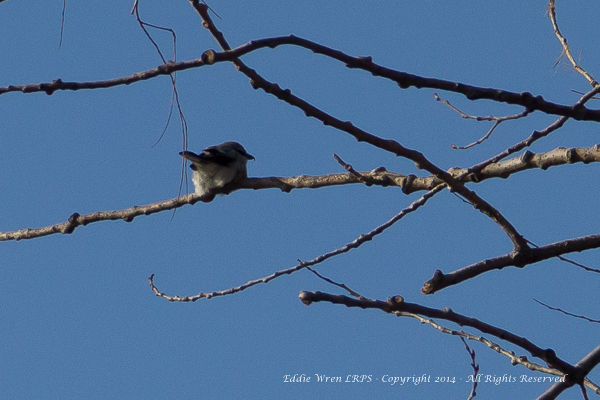
Northern Shrike (first year bird). The hooked upper mandible is an unmissable clue to identity.

Northern Shrike (first year bird). The hooked upper mandible is an unmistakable clue to identity.

On the way there, I came across a few resting White-tailed Deer and stalked them carefully so I could get some shots of them lying down.

Downy Woodpecker (female)

Downy Woodpecker (female)

At the south blind there were only a couple of Canada Geese walking around on the ice and yelling at my intrusion, plus a few Black-capped Chickadees feasting on sunflower seeds that someone had left on the hand-rail (something Tifft staff ask people not to do).

It was while I was watching the chickadees, however, that I saw one of the day’s two gems.  A first-year Northern Shrike (Lanius excubitor) settled in a tree above me — its youthfulness given away by some mottled coloration on its breast and belly.  The sharply hooked upper beak — very like some hawks and eagles — gives this genus of fairly small birds away in an instant but, as its name says, this is the northern species.  Its cousin, the Loggerhead Shrike (L. ludovicianus), spends its winters in the southern states.  After identifying the bird, through my binoculars, I only had time for one distant ‘identification’ shot with my camera before it flew off, so while there’s a photograph of it in this post, it certainly isn’t a masterpiece! {:-)

For the British people who read this blog, you may have noticed that the scientific name of the Northern Shrike is the same as that for the Great Grey Shrike that is found in Europe — in other words, it’s the same species.  Europe’s other shrike, the Red-backed (L. collurio) isn’t found in North America.

As my walk continued, I saw several other species of birds — all ones that could be expected here in late March.

Coyote crossing frozen lake

Coyote crossing frozen lake

At the other main blind, however — unsurprisingly called the North Blind — I was delighted to see a Coyote (Canis latrans) appear from behind the actual blind and walk away, over the ice on the lake, to the cat-tail bed on the far shore.  Again, I was rather distant but I was certainly able to get a few pleasing photos.  Coyotes certainly aren’t rare, they’re actually widespread, but getting to see one in broad daylight in such a photogenic setting is much less common.  My own question is whether or not this could have been one of the “Coywolf” hybrids that have been spreading out from northern Ontario for the past few decades.  Does anyone know the answer in relation to Western New York?

It annoys me intensely that I used to under-rate Tifft as a place to go.  I now know it to be a very well-worthwhile preserve to visit and I do so as often as I can.  It is rare that it doesn’t turn up something special.

Get further information about Tifft Nature Preserve here.

Anyone wishing to come along on any of the walks (weekly, except in winter) of the ‘Wildlife Watchers and Nature Photographers’ group, please e-mail:           wwnp [AT] eddiewren [DOT] com   (just replace the [AT] and the [DOT] with what they say, and leave no spaces.  This is done to reduce spam to that e-mail address).

27 March 2014  —  Eddie Wren


Birding at Buckhorn (Grand Island, NY), 16 March 2014

About a week ahead of the walk, meteorologists had forecast a realtively balmy 25F for the day of our Buckhorn Island State Park birding trip, but as each day went by, the promised temperature dropped by about a degree until — on the day of the walk — it was a mere 18F…. a little too chilly for some.  Even so, a few moderately intrepid individuals were still “up for it,” and we were rewarded with plenty sunshine even though its warmth was completely overcome by the breeze.

Tundra Swans (with a couple of Canada Geese) resting on an island in the Niagara River

Tundra Swans (with a couple of Canada Geese) resting on an island in the Niagara River

New person Donna, plus myself and Andrea were the first to arrive at Woods Creek canoe launch parking lot and we were all promptly caught napping when a small flock of birds was spotted in a nearby tree, stunningly highlighted in gold by the sunshine.  I think we must all have been momentarily mesmerised by what can genuinely be called a beautiful moment, to the extent that the cedar waxwings in question all flew away before any of us had the sense to “get the shot!”  Yes, “only” cedar waxwings, but you should have seen that light on them!

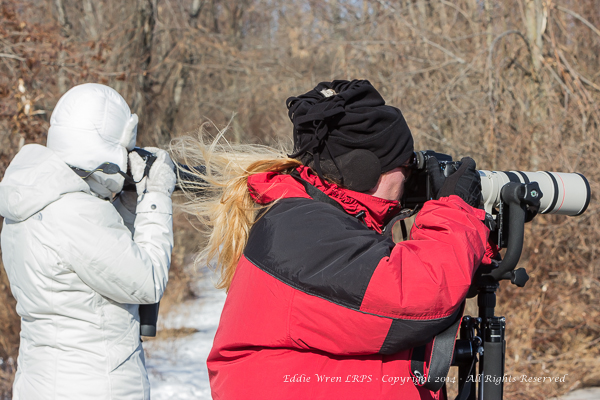
Donna and Andrea at work

Donna and Andrea at work

After the short walk through the woods to the river, it took only a few moments to pick out over 40 distant Tundra Swans, huddled down with their heads tucked in, for warmth.  A couple of them later lifted their heads and an additional swan flew in, and these two little incidents gave us a somewhat better look (see above).

Male and female Bufflehead

Male and female Bufflehead

With the vast majority of the waterbirds being well out into the Niagara River, it was inevitably longer lenses that were most useful.  However, courtesy of Andrea, I was trying out her Canon EF 70-200mm f/2.8 IS USM zoom lens and I’ve posted a few of the cropped results on this page. (Thanks, Andrea!)

Red-breasted Merganser - male

Red-breasted Merganser – male

For any birders not from this area on the US/Canadian border, it is worth adding that the Niagara River is classed as an Important Bird Area [IBA] by both countries.  Indeed, in winter, the Niagara River hosts up to 20 percent of the world population of Bonaparte’s Gulls, making it a globally significant IBA.

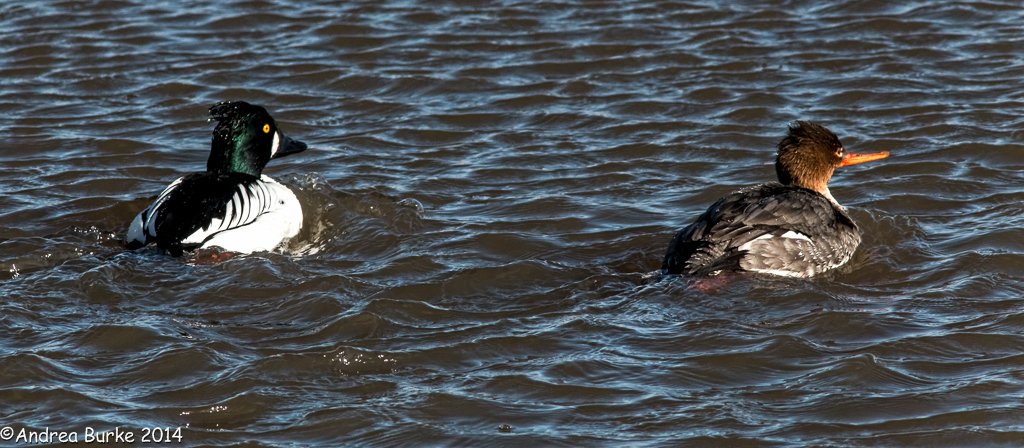
A male Common Goldeneye and a female Red-breasted Merganser

A male Common Goldeneye and a female Red-breasted Merganser

More information about the Niagara River IBA may be found at http://www.ibacanada.ca%2Fconservationplans%2Fonniagrarivercorridor.pdf

Three male Greater Scaup (Aythya marila) - a.k.a. just 'Scaup' in Britain

Three male Greater Scaup (Aythya marila) – a.k.a. just ‘Scaup’ in Britain

At the bridge over Woods Creek, right where the creek hits the Niagara, a few Greater Scaup, some Bufflehead and some Red-breasted Mergansers had come in closer to the shore, which made the challenge easier.  At this location, many of the photos here could have been taken with a pocket-sized camera (subject to cropping) — something which doesn’t happen as often as one might like.

Two Red-breasted Mergansers -- a definite female in the foreground, with an apparent first-winter bird behind.

Two Red-breasted Mergansers — a definite female in the foreground, with an apparent first-winter bird behind.

The bird species I noted during this walk were as follows (but anyone else that can add to the list, please let me know what you saw, and I’ll include them):

  • Tundra Swan (>40)
  • Canada Goose
  • Canvasback
  • Greater Scaup
  • Common Goldeneye
  • Bufflehead
  • Common Merganser
  • Red-breasted Merganser
  • Ring-billed Gull
  • Herring Gull
  • Greater Black-backed Gull
  • Rock Dove
  • American Crow
  • Black-capped Chickadee
  • Cedar Waxwing
  • American Tree Sparrow
  • Northern Cardinal

Andrea-Burke_140316-1442_ice-&-tree

Finally, on our way back to the cars, it would appear that neither Andrea nor I could resist being distracted for a few moments by what will hopefully be the last of the winter woodland sights for this year: Andrea by a water- and ice-bound dead tree and myself by one of one of my own favourite winter subjects — red  berries!

Just as the warlord in the movie 'Last of the Samurai' allegedly spent his life looking for the one perfect cherry blossom, I think I'm equally addicted to red berries! {:-)

Just as the warlord in the movie ‘Last of the Samurai’ allegedly spent his life looking for the one perfect cherry blossom, I think I’m equally addicted to red berries! {:-)

As for our Wildlife Watchers and Nature Photographers group, anyone in the WNY or South Ontario areas who might be interested in coming on some of our walks please just e-mail me on wwnp [at] eddiewren [dot] com

From the first of April until Nov/Dec, we will be out somewhere most weekends.

Eddie Wren


Basking in the Sun during Buffalo’s March 12 Blizzard!

Yes, I admit I was having fun at Buffalo’s expense.  I was very briefly in California with perfect (lucky!) timing to avoid the March snow

Heading south into the Santa Monica Mountains R.A., on the Pacific Coast Highway

Heading south into the Santa Monica Mountains R.A., on the Pacific Coast Highway

storm in WNY, and having finished my work at 2:30pm I hurried back to my hotel, swapped my suit for jeans and a T-shirt and headed south from Ventura down the Pacific Coast Highway, also known simply as “Route 1”.

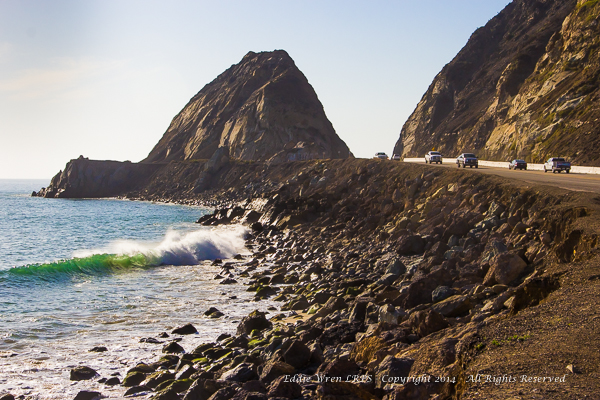
Looking southwards on the PCH, near Mugu Peak

Looking southwards on the PCH, near Mugu Peak


Retrospective of the previous photograph

Retrospective of the previous photograph

I was on my way to the beautiful hill roads in the Santa Monica mountains — an area I have been lucky enough to get to know quite well over the past few years — but it would take a better man than me to simply drive down “the PCH” without stopping to admire the views!

Two California Ground Squirrels. (The eye of the well-camouflaged, second animal is up and to the right from the eye of the front one.)

Two California Ground Squirrels. (The eye of the well-camouflaged and shaded, second animal is up and to the left from the eye of the front one.)


At one of my stops, I found and photographed a couple of California Ground Squirrels (Otospermophilus beecheyi), an interesting but skittish creature that lives in a communal burrow, but each of which allegedly has its own private entrance tunnel.

Name that bird!  It doesn't seem to be a female towhee and it's bill is to slender for it to be other species I can think of.  Does anyone know what it is, please?

Name that bird! It doesn’t seem to be a female towhee and it’s bill is to slender for it to be other species I can think of. Does anyone know what it is, please?


Nearby, I saw and photographed a small bird, in scrub, but for the life of me I can’t find anything quite like it in Sibley or my other bird books.  The nearest thing I can think of is a female towhee, but that doesn’t fit, either. Can anyone help me out with the I/D, please?

Around 5:40pm, I reached Decker Canyon Road and headed off up one of my favourite hill roads in that area.  (All of them are enjoyable but they are narrow so great care has to be taken on the many blind curves, in case someone is coming the other way.)  By that time of evening, the temperature was still in the mid-70s….. a little different to ‘back home’ in Buffalo!

The first proper 'hairpin' up Decker Canyon Road from the PCH. Further up the hill, the road follows the line of utility poles that are visible higher on the right-hand side of the photo.

The first proper ‘hairpin’ up Decker Canyon Road from the PCH. Further up the hill, the road follows the line of utility poles that are visible higher on the right-hand side of the photo.


West Seneca Oxbow Wetland Restoration, WNY

As someone who is not exactly from Western New York originally — {:-) — I had no idea that there even were any old oxbow lakes in the area, let alone one on which restoration efforts had been made, but there is and its in West Seneca.

The Buffalo Niagara Riverkeeper [BNRK] website states that “West Seneca’s oxbow wetland on Buffalo Creek is just a few miles upstream from the industrialized Buffalo River, a Great Lakes ‘Area of Concern’. As one of only three major wetlands in the lower Buffalo River watershed, it is considered a source area for future habitat and species restoration in the AOC.  Planning studies over the past 40 years have recommended that the oxbow site be protected.”

According to the  ERIE [Ecosystem Restoration through Interdisciplinary Exchange] webpage, “the restoration of the  oxbow wetland began in 2008 as part of the Buffalo River Watershed and AOC  restoration effort.  The project was led by BNRK and funded by a grant from the National Fish and Wildlife Foundation.

“In Fall 2009, six ERIE trainees became involved  in the restoration project… [and] donated over  1000 hours in fieldwork and analysis of flora, fauna, soils and groundwater.  The trainees developed a habitat restoration  and management plan for the 14-acre parcel of the oxbow. The plan used an  adaptive management framework to control invasive plant species and reintroduce  native plants to the site based on historical and nearby reference  communities. ”

To see pictures of the Oxbow and ERIE trainees working on the project (courtesy of Buffalo Niagara Riverkeeper), click here.

IfI can establish that there is public access to this site, or get us permission to visit, then this seems like a good venue for one of our ‘Wildlife Watchers & Nature Photographers’ group walks.  I’ll let you know the outcome of this.

When Catching a World-Record Fish Ends in Heartbreak

On 8th February this year, retired navy captain Rob Scott, from Minnesota caught a 4-pound Lake Trout (actually a species of char, not a trout — Salvelinus namaycush) while hand-lining through ice on Lac la Croix, on the Minnesota/Ontario border.  Shortly afterwards, he was checked by an Ontario Ministry of Natural Resources officer who recorded the fact that Rob had kept his one permitted lake trout — the Ontario provincial limit.  Ironically, if the retired captain had been just a short distance away, on the same lake, he would have still been in Minnesota and would have been allowed to keep two lake trout, and — as you will see below — on this occasion this matters.

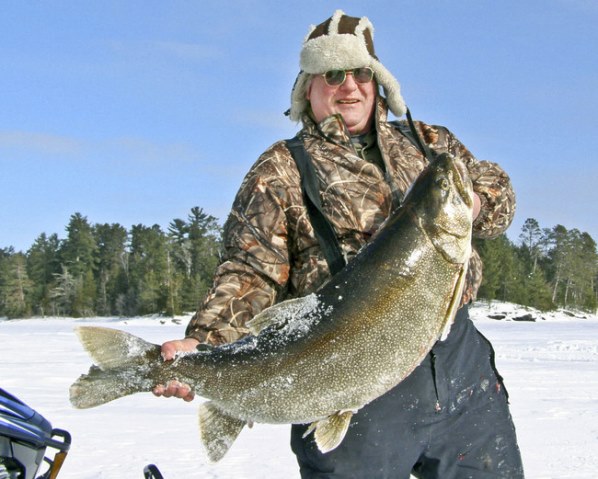
Retired navy captain Rob Scott and his 52-pound, world-record Lake Trout. February 2014

Retired navy captain Rob Scott and his 52-pound, world-record Lake Trout. February 2014

The problem came later that day when Rob hooked a second fish, which — at 52 pounds 3 ounces — was not only a new world record for lake trout but was a mind-boggling 77 percent larger than the previous, 18-year-old record of 29 pounds 6 ounces!

According to the book ‘Freshwater Gamefish of North America’, by Peter Thompson, the average weight of a lake trout is just 4-10 pounds, so at 52 pounds he probably thought he’d hooked a stray submarine!  In lake trout terms, it was a behemoth.

All went well until the same  Ontario Ministry of Natural Resources officer who had checked the 4-pound fish saw a subsequent newspaper report about the enormous laker, and regrettably this started an official ball rolling.  As a result, a Minnesota Department of Natural Resources officer confiscated the record-breaking fish from a Duluth taxidermist, and it was then destined to be handed over to Ontario officials.

As a retired police officer myself, I am very aware that rules are rules, and all that sort of stuff, but I really would like to ask Ontario officials just what they think they have actually achieved on this occasion, other than perhaps leaving a bad taste in the mouths of a lot of people.  Of course conservation is crucial, and the majority of fishehrmen I know and fish with would be the first to agree with that belief but in my own opinion, this time around, the Ontario people have scored a PR ‘own goal’ and have little, if anything, to actually be proud of.

Eddie Wren

Looking Forward to the Arrival of Swallows and Swifts (video)

My inspiration for this post comes directly from the Oakmoss Education blog, where Mary Jo Graham has written an interesting post about tree swallows.

What I would like to do is mention similarities and differences between the swallow family (more technically known as hirundines) in the USA and the swallows and martins in my native Britain, where there are only three such species, compared to America’s eight regular species and two ‘casual’ visitors.

video from BTO explaining how to identify UK hirundines & swifts

Two of these species are found as regular summer visitors in both countries. The bird that Brits call just the ‘swallow’ is known in the USA as the ‘barn swallow’ (Hirundo rustica).  The British birds spend their winters in Africa whereas the American birds head down into South America.  Interestingly, the North European subspecies are always white-breasted, whereas the American birds are a buff or cinnamon color underneath.  I’ve also seen many birds of this species in several African countries where some of them are very bright orange underneath, and I presume these are yet another subspecies — perhaps one that is resident year-round in the so-called  ‘Dark Continent’.

Is it worth knowing these differences, here in the States?  Well, if you travel within North America it might be, because two of the white-breasted, Eurasian subspecies are casual visitors here.  Hirundo rustica rustica and Hirundo rustica gutturalis are both occasionally seen in west and north Alaska, and the latter has also been seen in the Queen Charlotte Islands.

Another hirundine that is found on both sides of the Atalantic is the bank swallow (USA) or sand martin (Britain).  Again, the scientific name — Riparia riparia — shows that these birds are indeed the same species.

Britain’s third member of this family is the house martin (Delichon urbica), which has been seen on both sides of North America: Western Alaska, where it is a casual visitor in spring, and a record of a single bird at an island off the coast of Newfoundland.

Although not closely related to swallows, swifts cause some confusion to new birders.  North America has four regular species, only one of which — the chimney swift — is to be found on the eastern side of the continent.  Britain, on the other hand, only has one — the common swift (Apus apus) — which is an ‘accidental’ visitor to islands off both Alaska and Newfoundland.  Records of visits also exist for Bermuda and (quote) “probably the north east” of the USA.

At last! Satellites track the ‘missing years’ of American turtles’ migration

New insights have been gained into the “lost years” of loggerhead turtles.

Tiny satellite tags have tracked months-old animals in the uncertain period when they leave US coastal waters and head out into the wider Atlantic Ocean.

The data suggests the loggerheads can spend quite some time in the Sargasso Sea, possibly living in amongst floating mats of sargassum seaweed.

The observations are reported in a journal of the Royal Society.

“This has been a fun study because the data suggest the turtles are doing something a little bit unexpected to what everyone had assumed over the past few decades, and it boils down to having the right technology to be able to follow the animals,” said lead author Dr Kate Mansfield from University of Central Florida, Orlando….

But by using flexible mounts and preparation techniques usually found in a manicurist’s salon, Dr Mansfield’s team got the tags to stay on the animals’ shells for up to 220 days.

And it is with this new data that the scientists can see the young turtles dropping out of the gyre’s predominant currents into the middle of the Atlantic – into what is often referred to as the Sargasso Sea….

Read the full and fascinating article from the BBC.