Category Archives: Animals

Animals

WWNP group visit to the Montezuma National Wildlife Refuge [NWR], Seneca Falls, NY

Today’s WWNP group visit to the Montezuma NWR in the Finger Lakes region of New York State was a gem, both in terms of the weather and the 41 bird species seen.

About half of the group when we first arrived

About half of the group when we first arrived

When we arrived, about 8:00am, the sun was in a cloudless sky but there was still a fairly significant frost lying and large areas of the ponds were still under ice.  Initially we all went on the ‘Wildlife Drive’ around the Main Pool, which turned up a wealth of waterfowl, a solitary wader (lesser yellowlegs) and countless industrious muskrats.  After that, our five cars went their separate ways to various viewing areas and we re-grouped at noon, for lunch and a laugh, followed by a second trip around the preserve.

Trumpeter Swans. Copyright 2014, Eddie Wren, all rightes reserved.

Trumpeter Swans. Copyright 2014, Eddie Wren, all rightes reserved.


Northern Harrier (female). Copyright 2014, Eddie Wren, all rightes reserved.

Northern Harrier (female). Copyright 2014, Eddie Wren, all rightes reserved.


Lesser Yellowlegs. Copyright 2014, Eddie Wren, all rightes reserved.

Lesser Yellowlegs. Copyright 2014, Eddie Wren, all rightes reserved.

The birds seen were:

  • Trumpeter Swan
  • Snow Goose
  • Canada Goose
  • Green-winged Teal
  • Blue-winged Teal
  • Mallard
  • American Black Duck
  • Northern Pintail
  • Northern Shoveller
  • Gadwall
  • American Wigeon
  • Ring-necked Duck
  • Greater Scaup
  • Bufflehead
  • Hooded Merganser
  • Ruddy Duck (David G.)
  • Pied-billed Grebe
  • Double-crested Cormorant
  • Great Egret (Susan W.)
  • Osprey (at nest sites and flying)
  • Bald Eagle (including a surprising group of 11 immatures)
  • Northern Harrier
  • Red-tailed Hawk
  • American Kestrel
  • American Coot
  • Sandhill Crane
  • Killdeer
  • Lesser Yellowlegs
  • Ring-billed Gull
  • Herring Gull
Bufflehead (male). Copyright 2014, Eddie Wren.  All rights reserved.

Bufflehead (male). Copyright 2014, Eddie Wren. All rights reserved.

  • Rock Pigeon
  • Mourning Dove
  • Eastern Kingbird
  • Blue Jay
  • American Crow
  • Tree Swallow (migrating flock)
  • American Robin
  • European Starling
  • Song Sparrow
  • Red-winged Blackbird
  • Common Grackle
Muskrat. Copyright 2014, Eddie Wren.  All rights reserved.

Muskrat. Copyright 2014, Eddie Wren. All rights reserved.

If anyone who was with us at Montezuma has any more species’ names that need to be added to this list, please just let me know.

Similarly, would all the photographers who were in the group — i.e. most of you! — kindy forward two or three of your best shots to me so we can make a gallery of the day’s images that aren’t just by Andrea and I…. please!  {:-)

Speaking of Andrea, she has already sent me some great photos which I will be posting as soon as I can on page two of this day’s write-up and these will then be linked here.

  • Gallery of photos by Kathy Fenna, Esther Kowal-Bukata and Andrea Burke: click here

Eddie — 6 April, 2014

A Couple of Gems at Tifft Yesterday

After recently shaking off the tedium of a bad back that I’ve suffered virtually right through the winter, I took advantage of a few free hours yesterday to have a walk around the Tifft urban nature preserve.

Canada Goose in flight

Canada Goose in flight

When I arrived, at 8:00am, the temperature was just 18F (minus 8 Celsius) and there were no other cars in the parking lot.  On the small patches of open water, at Lake Kirsty, adjacent to the preserve offices, were four Herring Gulls, a solitary male Red-breasted Merganser, a pair of Hooded Mergansers and a dozen Canada Geese.

Black-capped Chickadee foraging

Black-capped Chickadee foraging

Anyway, wrapped up like the Michelin man, I set off through the woods on my way to the South Viewing Blind (hide) to look at a frozen lake!

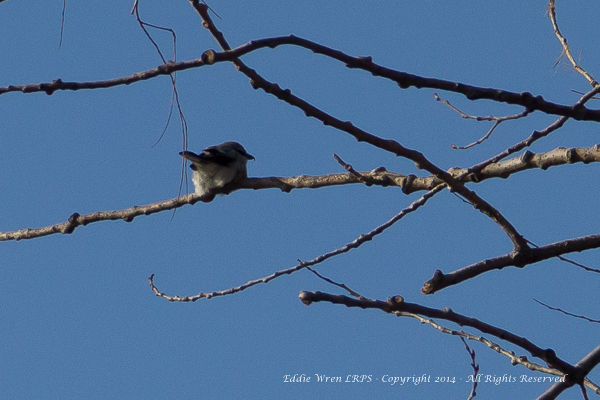
Northern Shrike (first year bird). The hooked upper mandible is an unmissable clue to identity.

Northern Shrike (first year bird). The hooked upper mandible is an unmistakable clue to identity.

On the way there, I came across a few resting White-tailed Deer and stalked them carefully so I could get some shots of them lying down.

Downy Woodpecker (female)

Downy Woodpecker (female)

At the south blind there were only a couple of Canada Geese walking around on the ice and yelling at my intrusion, plus a few Black-capped Chickadees feasting on sunflower seeds that someone had left on the hand-rail (something Tifft staff ask people not to do).

It was while I was watching the chickadees, however, that I saw one of the day’s two gems.  A first-year Northern Shrike (Lanius excubitor) settled in a tree above me — its youthfulness given away by some mottled coloration on its breast and belly.  The sharply hooked upper beak — very like some hawks and eagles — gives this genus of fairly small birds away in an instant but, as its name says, this is the northern species.  Its cousin, the Loggerhead Shrike (L. ludovicianus), spends its winters in the southern states.  After identifying the bird, through my binoculars, I only had time for one distant ‘identification’ shot with my camera before it flew off, so while there’s a photograph of it in this post, it certainly isn’t a masterpiece! {:-)

For the British people who read this blog, you may have noticed that the scientific name of the Northern Shrike is the same as that for the Great Grey Shrike that is found in Europe — in other words, it’s the same species.  Europe’s other shrike, the Red-backed (L. collurio) isn’t found in North America.

As my walk continued, I saw several other species of birds — all ones that could be expected here in late March.

Coyote crossing frozen lake

Coyote crossing frozen lake

At the other main blind, however — unsurprisingly called the North Blind — I was delighted to see a Coyote (Canis latrans) appear from behind the actual blind and walk away, over the ice on the lake, to the cat-tail bed on the far shore.  Again, I was rather distant but I was certainly able to get a few pleasing photos.  Coyotes certainly aren’t rare, they’re actually widespread, but getting to see one in broad daylight in such a photogenic setting is much less common.  My own question is whether or not this could have been one of the “Coywolf” hybrids that have been spreading out from northern Ontario for the past few decades.  Does anyone know the answer in relation to Western New York?

It annoys me intensely that I used to under-rate Tifft as a place to go.  I now know it to be a very well-worthwhile preserve to visit and I do so as often as I can.  It is rare that it doesn’t turn up something special.

Get further information about Tifft Nature Preserve here.

Anyone wishing to come along on any of the walks (weekly, except in winter) of the ‘Wildlife Watchers and Nature Photographers’ group, please e-mail:           wwnp [AT] eddiewren [DOT] com   (just replace the [AT] and the [DOT] with what they say, and leave no spaces.  This is done to reduce spam to that e-mail address).

27 March 2014  —  Eddie Wren


Basking in the Sun during Buffalo’s March 12 Blizzard!

Yes, I admit I was having fun at Buffalo’s expense.  I was very briefly in California with perfect (lucky!) timing to avoid the March snow

Heading south into the Santa Monica Mountains R.A., on the Pacific Coast Highway

Heading south into the Santa Monica Mountains R.A., on the Pacific Coast Highway

storm in WNY, and having finished my work at 2:30pm I hurried back to my hotel, swapped my suit for jeans and a T-shirt and headed south from Ventura down the Pacific Coast Highway, also known simply as “Route 1”.

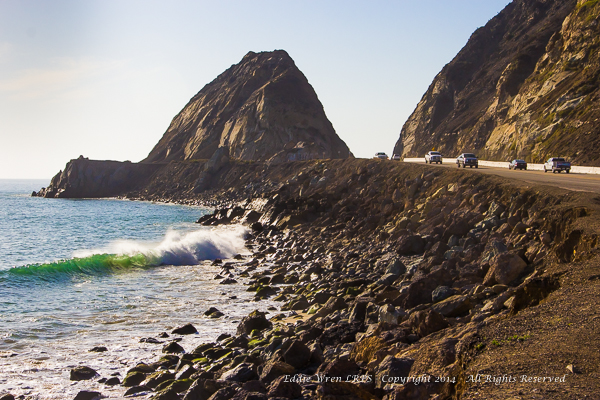
Looking southwards on the PCH, near Mugu Peak

Looking southwards on the PCH, near Mugu Peak


Retrospective of the previous photograph

Retrospective of the previous photograph

I was on my way to the beautiful hill roads in the Santa Monica mountains — an area I have been lucky enough to get to know quite well over the past few years — but it would take a better man than me to simply drive down “the PCH” without stopping to admire the views!

Two California Ground Squirrels. (The eye of the well-camouflaged, second animal is up and to the right from the eye of the front one.)

Two California Ground Squirrels. (The eye of the well-camouflaged and shaded, second animal is up and to the left from the eye of the front one.)


At one of my stops, I found and photographed a couple of California Ground Squirrels (Otospermophilus beecheyi), an interesting but skittish creature that lives in a communal burrow, but each of which allegedly has its own private entrance tunnel.

Name that bird!  It doesn't seem to be a female towhee and it's bill is to slender for it to be other species I can think of.  Does anyone know what it is, please?

Name that bird! It doesn’t seem to be a female towhee and it’s bill is to slender for it to be other species I can think of. Does anyone know what it is, please?


Nearby, I saw and photographed a small bird, in scrub, but for the life of me I can’t find anything quite like it in Sibley or my other bird books.  The nearest thing I can think of is a female towhee, but that doesn’t fit, either. Can anyone help me out with the I/D, please?

Around 5:40pm, I reached Decker Canyon Road and headed off up one of my favourite hill roads in that area.  (All of them are enjoyable but they are narrow so great care has to be taken on the many blind curves, in case someone is coming the other way.)  By that time of evening, the temperature was still in the mid-70s….. a little different to ‘back home’ in Buffalo!

The first proper 'hairpin' up Decker Canyon Road from the PCH. Further up the hill, the road follows the line of utility poles that are visible higher on the right-hand side of the photo.

The first proper ‘hairpin’ up Decker Canyon Road from the PCH. Further up the hill, the road follows the line of utility poles that are visible higher on the right-hand side of the photo.


West Seneca Oxbow Wetland Restoration, WNY

As someone who is not exactly from Western New York originally — {:-) — I had no idea that there even were any old oxbow lakes in the area, let alone one on which restoration efforts had been made, but there is and its in West Seneca.

The Buffalo Niagara Riverkeeper [BNRK] website states that “West Seneca’s oxbow wetland on Buffalo Creek is just a few miles upstream from the industrialized Buffalo River, a Great Lakes ‘Area of Concern’. As one of only three major wetlands in the lower Buffalo River watershed, it is considered a source area for future habitat and species restoration in the AOC.  Planning studies over the past 40 years have recommended that the oxbow site be protected.”

According to the  ERIE [Ecosystem Restoration through Interdisciplinary Exchange] webpage, “the restoration of the  oxbow wetland began in 2008 as part of the Buffalo River Watershed and AOC  restoration effort.  The project was led by BNRK and funded by a grant from the National Fish and Wildlife Foundation.

“In Fall 2009, six ERIE trainees became involved  in the restoration project… [and] donated over  1000 hours in fieldwork and analysis of flora, fauna, soils and groundwater.  The trainees developed a habitat restoration  and management plan for the 14-acre parcel of the oxbow. The plan used an  adaptive management framework to control invasive plant species and reintroduce  native plants to the site based on historical and nearby reference  communities. ”

To see pictures of the Oxbow and ERIE trainees working on the project (courtesy of Buffalo Niagara Riverkeeper), click here.

IfI can establish that there is public access to this site, or get us permission to visit, then this seems like a good venue for one of our ‘Wildlife Watchers & Nature Photographers’ group walks.  I’ll let you know the outcome of this.

When Catching a World-Record Fish Ends in Heartbreak

On 8th February this year, retired navy captain Rob Scott, from Minnesota caught a 4-pound Lake Trout (actually a species of char, not a trout — Salvelinus namaycush) while hand-lining through ice on Lac la Croix, on the Minnesota/Ontario border.  Shortly afterwards, he was checked by an Ontario Ministry of Natural Resources officer who recorded the fact that Rob had kept his one permitted lake trout — the Ontario provincial limit.  Ironically, if the retired captain had been just a short distance away, on the same lake, he would have still been in Minnesota and would have been allowed to keep two lake trout, and — as you will see below — on this occasion this matters.

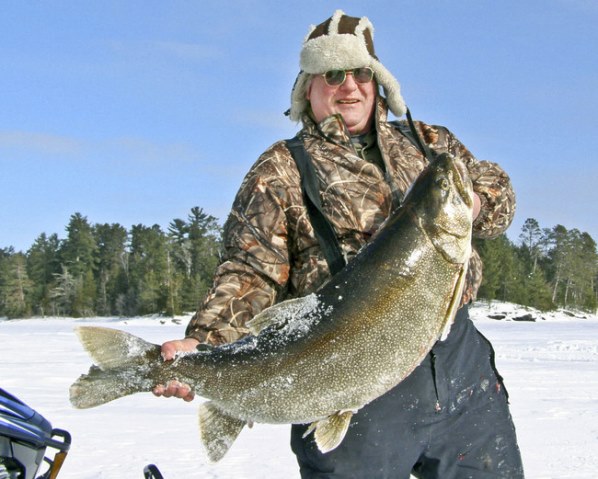
Retired navy captain Rob Scott and his 52-pound, world-record Lake Trout. February 2014

Retired navy captain Rob Scott and his 52-pound, world-record Lake Trout. February 2014

The problem came later that day when Rob hooked a second fish, which — at 52 pounds 3 ounces — was not only a new world record for lake trout but was a mind-boggling 77 percent larger than the previous, 18-year-old record of 29 pounds 6 ounces!

According to the book ‘Freshwater Gamefish of North America’, by Peter Thompson, the average weight of a lake trout is just 4-10 pounds, so at 52 pounds he probably thought he’d hooked a stray submarine!  In lake trout terms, it was a behemoth.

All went well until the same  Ontario Ministry of Natural Resources officer who had checked the 4-pound fish saw a subsequent newspaper report about the enormous laker, and regrettably this started an official ball rolling.  As a result, a Minnesota Department of Natural Resources officer confiscated the record-breaking fish from a Duluth taxidermist, and it was then destined to be handed over to Ontario officials.

As a retired police officer myself, I am very aware that rules are rules, and all that sort of stuff, but I really would like to ask Ontario officials just what they think they have actually achieved on this occasion, other than perhaps leaving a bad taste in the mouths of a lot of people.  Of course conservation is crucial, and the majority of fishehrmen I know and fish with would be the first to agree with that belief but in my own opinion, this time around, the Ontario people have scored a PR ‘own goal’ and have little, if anything, to actually be proud of.

Eddie Wren

At last! Satellites track the ‘missing years’ of American turtles’ migration

New insights have been gained into the “lost years” of loggerhead turtles.

Tiny satellite tags have tracked months-old animals in the uncertain period when they leave US coastal waters and head out into the wider Atlantic Ocean.

The data suggests the loggerheads can spend quite some time in the Sargasso Sea, possibly living in amongst floating mats of sargassum seaweed.

The observations are reported in a journal of the Royal Society.

“This has been a fun study because the data suggest the turtles are doing something a little bit unexpected to what everyone had assumed over the past few decades, and it boils down to having the right technology to be able to follow the animals,” said lead author Dr Kate Mansfield from University of Central Florida, Orlando….

But by using flexible mounts and preparation techniques usually found in a manicurist’s salon, Dr Mansfield’s team got the tags to stay on the animals’ shells for up to 220 days.

And it is with this new data that the scientists can see the young turtles dropping out of the gyre’s predominant currents into the middle of the Atlantic – into what is often referred to as the Sargasso Sea….

Read the full and fascinating article from the BBC.

America’s Bats in Danger from a Disease that First Occurred here in Upstate New York

It is quite possible that you have already heard about the White-nose Syndrome that is doing terrible damage to cave-dwelling bats in the USA, but what exactly is it!

According to the USGS, “White-nose syndrome (WNS) is an emergent disease of hibernating bats that has spread from the northeastern to the central United States at an alarming rate. Since the winter of 2007-2008, millions of insect-eating bats in 22 states and five Canadian provinces have died from this devastating disease. The disease is named for the white fungus, Pseudogymnoascus destructans, that infects skin of the muzzle, ears, and wings of hibernating bats.”

White-nose  syndrome was first discovered in North America in upstate New York in February 2006,  in  a cave adjoining a commercial cave visited by 200,000 people per year.  The fungus appears to have been introduced to North America  from Europe. It has  been found on cave bats in 12 countries in Europe, where bats appear to be adapted to,  and unaffected by, the fungus.  Because bats do not travel between the  continents, this strongly suggests the fungus was newly introduced to North  America by people — likely cave visitors who transported it on  their gear or clothing.

An estimated 6.7 million bats have died since 2006 because of an outbreak of white-nose syndrome.  It has  wiped out entire colonies and left caves littered with the bones of dead bats.  The epidemic is considered the worst wildlife disease outbreak in North American  history and shows no signs of slowing down. It threatens to drive some bats  extinct and could do real harm to the pest-killing services that bats provide,  worth billions of dollars each year, in the United States. [Source: Center for Biological Diversity]

View photos here.

The latest news articles on this disease are available from White-noseSyndrome.org, here, and this includes the fact that the U.S. Fish and Wildlife Service is awarding $1.4 million in grants for work on the deadly bat disease, with a further $2 million available in a second round of grants.

What can you do to help?

The key things are:

Avoid possible spread of WNS by humans

    • Stay out of caves and mines where bats are known – or suspected – to hibernate (hibernacula) in all states.

Honor cave closures and gated caves.

 Avoid disturbing bats

  • Stay out of all hibernacula when bats are hibernating (winter).

 Be observant

  • Report unusual bat behavior to your state natural resource agency, including bats flying during the day when they should be hibernating (December through March) and bats roosting in sunlight on the outside of structures. More difficult to discern is unusual behavior when bats are not hibernating (April through September); however, bats roosting in the sunlight or flying in the middle of the day would be unusual. Bats unable to fly or struggling to get off the ground would also be unusual.

Click here for further advice.

(Compiled by Eddie Wren, from relevant websites)