Category Archives: North America (preserves & reserves)

Wildlife Reserves, etc., in North America

A Natural History of North American Trees – Donald Culross Peattie (book review)

How interesting could it be to read a book solely about different tree species?  The answer — for anyone curious about the various facets of nature — is: Intensely!

Book_Peattie_NHNATrees-2This book not only makes clear its author’s encyclopaedic knowledge of his subject but is also written with an eloquence we no longer tend to witness.  In other words, rather than even remotely being dry or boring, this book is both fascinating and an absolute delight to read. [EW]

The e-book ‘Lybrary’ review of A Natural History of North American Trees is no exaggeration and reads as follows:

“‘A volume for a lifetime’ is how The New Yorker described the first of Donald Culross Peatie’s two books about American trees published in the 1950s. In this one-volume edition, modern readers are introduced to one of the best nature writers of the last century. As we read Peattie’s eloquent and entertaining accounts of American trees, we catch glimpses of our country’s history and past daily life that no textbook could ever illuminate so vividly.

“Here you’ll learn about everything from how a species was discovered to the part it played in our country’s history. Pioneers often stabled an animal in the hollow heart of an old sycamore, and the whole family might live there until they could build a log cabin. The tuliptree, the tallest native hardwood, is easier to work than most softwood trees; Daniel Boone carved a sixty-foot canoe from one tree to carry his family from Kentucky into Spanish territory. In the days before the Revolution, the British and the colonists waged an undeclared war over New England’s white pines, which made the best tall masts for fighting ships.

“It’s fascinating to learn about the commercial uses of various woods — for paper, fine furniture, fence posts, matchsticks, house framing, airplane wings, and dozens of other preplastic uses. But we cannot read this book without the occasional lump in our throats. The American elm was still alive when Peattie wrote, but as we read his account today we can see what caused its demise. Audubon’s portrait of a pair of loving passenger pigeons in an American beech is considered by many to be his greatest painting. It certainly touched the poet in Donald Culross Peattie as he depicted the extinction of the passenger pigeon when the beech forest was destroyed.

“A Natural History of North American Trees gives us a picture of life in America from its earliest days to the middle of the last century. The information is always interesting, though often heartbreaking. While Peattie looks for the better side of man’s nature, he reports sorrowfully on the greed and waste that have doomed so much of America’s virgin forest.”


Links to Wildlife-related Organizations and Websites in New York State

Back to the main LINKS page

WNY

Buffalo & Erie County Botanical Gardens

Buffalo Audubon Society

Buffalo Ornithological Society

Nature Conservancy – Central & Western New York

NYS Department of Environmental Conservation – Western New York

Rochester Area Mycological Association – RAMA

Roger Tory Peterson Institute of Natural History (Jamestown)

Sierra Club – Niagara Group

Tifft Urban Nature Preserve, Buffalo


OTHER

Audubon – New York State (with Chapter links)

Audubon – New York State – Calendar of Events

Cornell Laboratory of Ornithology – All About Birds

NYOG – New York Odonate Group (Yahoo groups)


Please feel free to add a comment below, recommending additional websites that should be included on this list.

WWP Group Walk – ‘Identifying Trees in Winter’ – Buffalo Audubon Society

John Sly (Photo copyright 2014, Gerry McIntyre. All rights reserved)

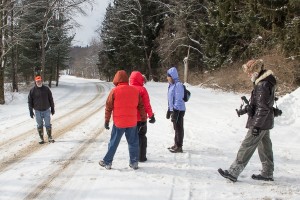
Identifying winter trees?  I often have difficulty identifying them in summer!  It would appear that I’m not the only one, either, because several members of our WWP group came out in today’s modestly below-freezing temperatures and had an enjoyable and instructive walk with John Sly, one of Buffalo Audubon Society’s team of knowledgeable volunteers.  Indeed, John was able to pass on so much information that it was a challenge to keep up.

140215-02_Beaver-Meadow_copyright-2014_Gerry-McIntyre

Beaver Meadow Arboretum

Beaver Meadow Arboretum

Deciduous twigs opposite or alternate?  If opposite each other then “MAD Horses” are responsible! (Maple, Ash, Dogwood or Horse Chestnut – a great acronym that should prove easy to remember.)

White Pine

White Pine

Compound leaves or simple?  Well yes, this was a question about summer trees, not winter, but as we were apparently not willing to leave any leaf unturned, the questions were still answered.

Display of leaves at the Arboretum

Display of leaves at the Arboretum

Pines with needles in bundles?  If in twos, it could be Red Pine or Jack Pine (though they are very different) but if the needles are in fives it is the remarkable Eastern White Pine – a tree whose timber caused ructions inthe build up to the Revolutionary War.

This wasn’t all, of course.  There were still bark, buds and seeds to consider, not to mention the habitats in which each species found its favoured niche.

Prior to starting the walk, we had the opportunity to briefly look at at John’s own display collection of over 80 species of leaves, together with various seeds, pine cones, twigs and so on.  Interestingly, when I asked him, he added that the leaves would keep their green colouration and remain usable for display for about 15 years.

140215-03_Beaver-Meadow_copyright-2014_Gerry-McIntyre

Gerry, balancing flash exposure with background snow

Gerry, balancing flash exposure with background snow


Key little tidbits came out during this ‘classroom’ session, such as the indentations in some maple leaves being ‘U’ shaped, which indicated sUgar maple, and others being V shaped. John also passed around several of his older tree-identification books — mostly just printed with monochrome illustrations, unlike today’s brightly-coloured volumes — but showed us the detail in the typically larger illustrations, an aspect which spoke for itself.

Detailed explanation

Detailed explanations

During the first two-thirds of our walk, snow fell quite heavily, and this meant that those of us with DSLR cameras which were not weather-proof had to be cautious about the water getting in.  And some of us (meaning me!) had forgotten to to pack our waterproof compact camera, too, so several photo opportunities were lost!

What started out, perhaps, as just a good reason to get outside and have a winter walk, turned out to be extremely interesting and I,

And then the sun came out!for one, will look for other opportunities to go out on John’s various guided walks because — to use a well-known phrase — he’s a man who has clearly forgotten more about trees than I will likely ever know. And just to end the walk on a high note, the sun came out and graced us with its presence on our way back to the BAS buildings.

Finally, my thanks to Gerry McIntyre, for sharing some of his photos with us in this blog.

Eddie Wren

The Astonishing Wildflowers of Texas

Through the depths of winter in Buffalo (NY) I tend to watch a lot of wildlife documentaries, and one that I saved on the DVR a couple of years ago does tend to make a regular appearance.

‘Wildflowers: Seeds of History’ is the story of Lady Bird Johnson’s flower conservation work in Texas, and some of the KLRU footage is wonderful.

You can view the whole episode (58 minutes) online, at: http://www.klru.org/episode/wildflowers-seeds-of-history/wildflowers-seeds-of-history/

The Lady Bird Johnson Wildflower Center websits is at: http://www.wildflower.org/

uswildflowers.com provides a page of links for the state at: http://uswildflowers.com/stateref.php?State=TX

Eddie

Wintering gulls and other birds of the Niagara River

29 December 2013

Of the 43 species of gulls worldwide, 19 have been identified on the Niagara River.  Among their ranks are an estimated 50,000 to 75,000 Bonaparte’s Gulls – as much as 10 per cent of the world’s population of this one species alone.[i]

With the culinary excesses of Christmas fading quickly from memory, if not necessarily from the waistline, today’s outing of the Buffalo Audubon Society was a breath of fresh air – albeit very chilly, breezy air. Seven members of our “Wildlife Watchers and Photographers (WNY)” group were there.

Erie Basin Marina, Buffalo NY

Erie Basin Marina, Buffalo NY

The observation tower at the city’s Erie Basin Marina was our starting point and an adult bald eagle (Haliaeetus leucocephalus)[i] flew directly overhead as we arrived.  However, several duck hunters blasting away on the breakwaters a few hundred yards offshore had contributed to the vast majority of waterfowl being a long distance away. Visible through binoculars only as vaguely-dotted, darker areas, several thousand greater scaup (Aythya marila) and, in a separate raft, a similarly huge number of common mergansers (Mergus  merganser) were revealed by spotting scopes.  Canvasbacks (Aythya valisineria) and – rather inevitably – mallard (Anas platyrhynchos) were also present, but so were a few less-common American  Black Ducks (Anas rubripes).

Recent sightings of up to 3 snowy owls (Bubo scandiacus) on the breakwaters now being used by the duck shooters understandably were not happening during our visit. If owls are as ‘wise’ as they are said to be they would be hiding as far away from any hunters as possible, just in case there were any trigger-happy individuals out there who might shoot at anything that moved.  Such mindless killings are sadly not unheard of.

One little gull (dark under-wings) among Bonaparte’s gulls

One little gull (dark underwings) among Bonaparte’s gulls

So, leaving the pounding of shotguns behind, we soon moved on and headed for the very northern tip of Squaw Island,[i] on the east/U.S. side of the northbound river.  Here a swirling patch of water, emerging from beneath lock gates, was bringing tiny fish and presumably other food items to the surface where scores of Bonaparte’s gulls (Chroicocephalus philadelphia) were waiting.  Among the Bonepartes, a solitary little gull (Hydrocoloeus minutus or debatably Larus minutus)[ii] was feeding just as avidly – its dark underwings the only obvious give-away that it was indeed a separate species from its light-winged cousins.

Common Loon in winter plumage

Common Loon in winter plumage

Nearby, at the end of the narrow jetty, an adult common loon (Gavia immer) in winter plumage was swimming and diving.  A little further out, a raft  of floating birds included many ring-billed gulls (Larus delawarensis), several American herring gulls (Larus argentatus smithsonianus) and some American coot (Fulica americana).  Many of us were pleasantly surprised to see a belted kingfisher (Megaceryle alcyon) fly overhead, a long way north of its normal winter range, but our guide for the day – Buffalo Audubon’s Tom Kerr (below) – pointed out that as migration is tied to food availability and as the powerful Niagara River almost never freezes-over completely, birds  such as “belteds” are commonly able to stay, year-round. Our next stop was Goat Island, one of the two islands that split the river into three sections immediately above the world-famous Niagara Falls.  Just as at Squaw Island, one can drive across a bridge onto goat Island, but a glance down at the water thrashing and

Tom Kerr, professional naturalist for Buffalo Audubon Society, and an excellent birder

Tom Kerr, professional naturalist for Buffalo Audubon Society, and an excellent birder

battering its way past underneath as it heads for an imminent, spectacular plunge over the edge, does tend to make one hope the bridge is particularly well-built! On rocks at the upstream (i.e. eastern) end of the island, many gulls were resting, including many ring-billed but also a glaucous gull (Larus hyperboreus), lesser black-backed gulls (Larus fuscus) and a great black-backed gull (Larus marinus) that flew by.  One harlequin duck (Histrionicus histrionicus) was seen, sitting on rocks.  Another bird at Goat Island that initially seemed as unlikely as had the belted kingfisher at Squaw Island was a spotted sandpiper (Actitis macularius or debatably Actitis macularia).

The Canadian hydro-electric power station outflow on the left, and the American one on the right, from the 'Power Vista'

The Canadian hydro-electric power station outflow, high left, and the American one lower right, from the ‘Power Vista’

A few miles north of the city of Niagara Falls, the river passes between two huge
hydro-electric power stations – one (on the left/ west bank) Canadian and the other, of course, American – but where the water escapes back into the river the turmoil and currents are extraordinary, once again bringing a lot of food to the surface and attracting gulls.  This time, though, it is the larger species and in among them we had the pleasure of seeing more glaucous gulls plus an Iceland gull (Larus glaucoides) and at least one Thayer’s gull (Larus thayeri).  The last viewpoint of the eight-hour birding trip along the entire, 35-mile length of the Niagara River was on the south shore of Lake Ontario, adjacent to Old Fort Niagara and near the river mouth.  This is a location that can produce spectacular birding days but on this occasion gave us ‘just’ black scoter (Melanitta nigra or, more recently, Melanitta americana to separate it from the very similar ‘common scoter’ in Europe), white-winged scoter (Melanitta fusca deglandi), oldsquaw – a.k.a. long-tailed duck – (Clangula hyemalis) and another common loon. More than one-fifth – nine in total – of all the world’s species of gulls were identified on this trip, with plenty other birds to watch, as well.  It was a highly enjoyable and rewarding day out, for which our thanks go to the Buffalo Audubon Society, Tom Kerr, and several other very knowledgeable birders who were all keen to help visitors identify and understand what they were seeing.

Eddie Wren

______________________________________


Anyone in Western New York State who is interested in joining

Wildlife Watchers

please just e-mail the owner of this blog and introduce yourself


[i] Source: Niagara Parks, at http://www.niagaraparks.com/niagara-falls-attractions/nature-activities.html

[i] Scientific names – less-accurately known as ‘Latin names’ despite many being of Greek origin – are included to clarify species identification for any readers from countries such as my native Britain where the common names for the same species are frequently different.

[i] Squaw Island Park provides support for part of the international railroad bridge that crosses to Canada and may be reached via a side road that is located on Niagara Street, about 200 yards northwest of its intersection with Tonawanda Street, all of which is just north of the intersection between I-190 and the Scajaquada Expressway (Route 198).

[ii] Experts sometimes debate over the precise naming of species and the result is that, until such disputes are resolved, some creatures get landed with two alternate scientific names. There are two of these in this summary.

___________________________________

Keywords: Niagara River, Buffalo Audubon Society, Tom Kerr, Eddie Wren, Wildlife Watchers and Photographers, Goat Island, Squaw Island Park, Niagara Falls, Western New York, WNY, USA, winter, birding, birds, bird watching, December, gulls, Thayer’s gull, glaucous gull, Iceland gull, Bonaparte’s gull, little gull, spotted sandpiper, common merganser, goosander, canvasback, belted kingfisher, common loon, great northern diver, black scoter, white-winged scoter, Power Vista,


US experiences largest influx of snowy owls in decades (video)

Feb. 04, 2014 – 2:11 – Huge number of birds fly south from the Arctic

Winter on Cape Cod is a solitary time. The beaches are empty and the summer tourists a memory, but this year visitors from the far north are drawing quite a crowd.

Snowy owls have flown down from the arctic tundra, spotted as far south as Florida and many more are being seen in the Northeast. Experts say it’s the largest migration of snowy owls to the United States in decades….

Read the full article and view a two-minute video from Cape Cod, at: http://www.foxnews.com/science/2014/02/04/massive-migration-snowy-owls-breaks-record/


See also:  Snowy Owls in Western New York, January 2014