Category Archives: North America (preserves & reserves)

Wildlife Reserves, etc., in North America

WWNP group visit to the Montezuma National Wildlife Refuge [NWR], Seneca Falls, NY

Today’s WWNP group visit to the Montezuma NWR in the Finger Lakes region of New York State was a gem, both in terms of the weather and the 41 bird species seen.

About half of the group when we first arrived

About half of the group when we first arrived

When we arrived, about 8:00am, the sun was in a cloudless sky but there was still a fairly significant frost lying and large areas of the ponds were still under ice.  Initially we all went on the ‘Wildlife Drive’ around the Main Pool, which turned up a wealth of waterfowl, a solitary wader (lesser yellowlegs) and countless industrious muskrats.  After that, our five cars went their separate ways to various viewing areas and we re-grouped at noon, for lunch and a laugh, followed by a second trip around the preserve.

Trumpeter Swans. Copyright 2014, Eddie Wren, all rightes reserved.

Trumpeter Swans. Copyright 2014, Eddie Wren, all rightes reserved.


Northern Harrier (female). Copyright 2014, Eddie Wren, all rightes reserved.

Northern Harrier (female). Copyright 2014, Eddie Wren, all rightes reserved.


Lesser Yellowlegs. Copyright 2014, Eddie Wren, all rightes reserved.

Lesser Yellowlegs. Copyright 2014, Eddie Wren, all rightes reserved.

The birds seen were:

  • Trumpeter Swan
  • Snow Goose
  • Canada Goose
  • Green-winged Teal
  • Blue-winged Teal
  • Mallard
  • American Black Duck
  • Northern Pintail
  • Northern Shoveller
  • Gadwall
  • American Wigeon
  • Ring-necked Duck
  • Greater Scaup
  • Bufflehead
  • Hooded Merganser
  • Ruddy Duck (David G.)
  • Pied-billed Grebe
  • Double-crested Cormorant
  • Great Egret (Susan W.)
  • Osprey (at nest sites and flying)
  • Bald Eagle (including a surprising group of 11 immatures)
  • Northern Harrier
  • Red-tailed Hawk
  • American Kestrel
  • American Coot
  • Sandhill Crane
  • Killdeer
  • Lesser Yellowlegs
  • Ring-billed Gull
  • Herring Gull
Bufflehead (male). Copyright 2014, Eddie Wren.  All rights reserved.

Bufflehead (male). Copyright 2014, Eddie Wren. All rights reserved.

  • Rock Pigeon
  • Mourning Dove
  • Eastern Kingbird
  • Blue Jay
  • American Crow
  • Tree Swallow (migrating flock)
  • American Robin
  • European Starling
  • Song Sparrow
  • Red-winged Blackbird
  • Common Grackle
Muskrat. Copyright 2014, Eddie Wren.  All rights reserved.

Muskrat. Copyright 2014, Eddie Wren. All rights reserved.

If anyone who was with us at Montezuma has any more species’ names that need to be added to this list, please just let me know.

Similarly, would all the photographers who were in the group — i.e. most of you! — kindy forward two or three of your best shots to me so we can make a gallery of the day’s images that aren’t just by Andrea and I…. please!  {:-)

Speaking of Andrea, she has already sent me some great photos which I will be posting as soon as I can on page two of this day’s write-up and these will then be linked here.

  • Gallery of photos by Kathy Fenna, Esther Kowal-Bukata and Andrea Burke: click here

Eddie — 6 April, 2014

A Couple of Gems at Tifft Yesterday

After recently shaking off the tedium of a bad back that I’ve suffered virtually right through the winter, I took advantage of a few free hours yesterday to have a walk around the Tifft urban nature preserve.

Canada Goose in flight

Canada Goose in flight

When I arrived, at 8:00am, the temperature was just 18F (minus 8 Celsius) and there were no other cars in the parking lot.  On the small patches of open water, at Lake Kirsty, adjacent to the preserve offices, were four Herring Gulls, a solitary male Red-breasted Merganser, a pair of Hooded Mergansers and a dozen Canada Geese.

Black-capped Chickadee foraging

Black-capped Chickadee foraging

Anyway, wrapped up like the Michelin man, I set off through the woods on my way to the South Viewing Blind (hide) to look at a frozen lake!

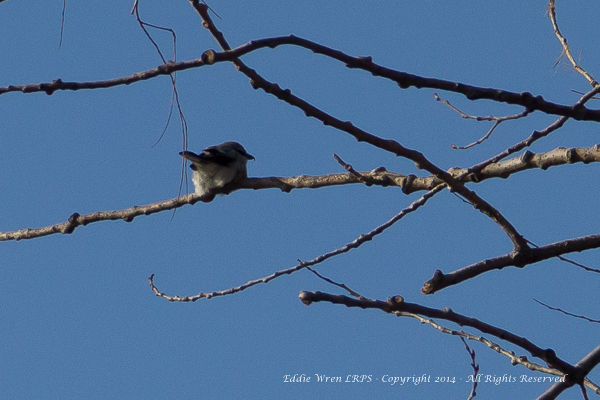
Northern Shrike (first year bird). The hooked upper mandible is an unmissable clue to identity.

Northern Shrike (first year bird). The hooked upper mandible is an unmistakable clue to identity.

On the way there, I came across a few resting White-tailed Deer and stalked them carefully so I could get some shots of them lying down.

Downy Woodpecker (female)

Downy Woodpecker (female)

At the south blind there were only a couple of Canada Geese walking around on the ice and yelling at my intrusion, plus a few Black-capped Chickadees feasting on sunflower seeds that someone had left on the hand-rail (something Tifft staff ask people not to do).

It was while I was watching the chickadees, however, that I saw one of the day’s two gems.  A first-year Northern Shrike (Lanius excubitor) settled in a tree above me — its youthfulness given away by some mottled coloration on its breast and belly.  The sharply hooked upper beak — very like some hawks and eagles — gives this genus of fairly small birds away in an instant but, as its name says, this is the northern species.  Its cousin, the Loggerhead Shrike (L. ludovicianus), spends its winters in the southern states.  After identifying the bird, through my binoculars, I only had time for one distant ‘identification’ shot with my camera before it flew off, so while there’s a photograph of it in this post, it certainly isn’t a masterpiece! {:-)

For the British people who read this blog, you may have noticed that the scientific name of the Northern Shrike is the same as that for the Great Grey Shrike that is found in Europe — in other words, it’s the same species.  Europe’s other shrike, the Red-backed (L. collurio) isn’t found in North America.

As my walk continued, I saw several other species of birds — all ones that could be expected here in late March.

Coyote crossing frozen lake

Coyote crossing frozen lake

At the other main blind, however — unsurprisingly called the North Blind — I was delighted to see a Coyote (Canis latrans) appear from behind the actual blind and walk away, over the ice on the lake, to the cat-tail bed on the far shore.  Again, I was rather distant but I was certainly able to get a few pleasing photos.  Coyotes certainly aren’t rare, they’re actually widespread, but getting to see one in broad daylight in such a photogenic setting is much less common.  My own question is whether or not this could have been one of the “Coywolf” hybrids that have been spreading out from northern Ontario for the past few decades.  Does anyone know the answer in relation to Western New York?

It annoys me intensely that I used to under-rate Tifft as a place to go.  I now know it to be a very well-worthwhile preserve to visit and I do so as often as I can.  It is rare that it doesn’t turn up something special.

Get further information about Tifft Nature Preserve here.

Anyone wishing to come along on any of the walks (weekly, except in winter) of the ‘Wildlife Watchers and Nature Photographers’ group, please e-mail:           wwnp [AT] eddiewren [DOT] com   (just replace the [AT] and the [DOT] with what they say, and leave no spaces.  This is done to reduce spam to that e-mail address).

27 March 2014  —  Eddie Wren


Birding at Buckhorn (Grand Island, NY), 16 March 2014

About a week ahead of the walk, meteorologists had forecast a realtively balmy 25F for the day of our Buckhorn Island State Park birding trip, but as each day went by, the promised temperature dropped by about a degree until — on the day of the walk — it was a mere 18F…. a little too chilly for some.  Even so, a few moderately intrepid individuals were still “up for it,” and we were rewarded with plenty sunshine even though its warmth was completely overcome by the breeze.

Tundra Swans (with a couple of Canada Geese) resting on an island in the Niagara River

Tundra Swans (with a couple of Canada Geese) resting on an island in the Niagara River

New person Donna, plus myself and Andrea were the first to arrive at Woods Creek canoe launch parking lot and we were all promptly caught napping when a small flock of birds was spotted in a nearby tree, stunningly highlighted in gold by the sunshine.  I think we must all have been momentarily mesmerised by what can genuinely be called a beautiful moment, to the extent that the cedar waxwings in question all flew away before any of us had the sense to “get the shot!”  Yes, “only” cedar waxwings, but you should have seen that light on them!

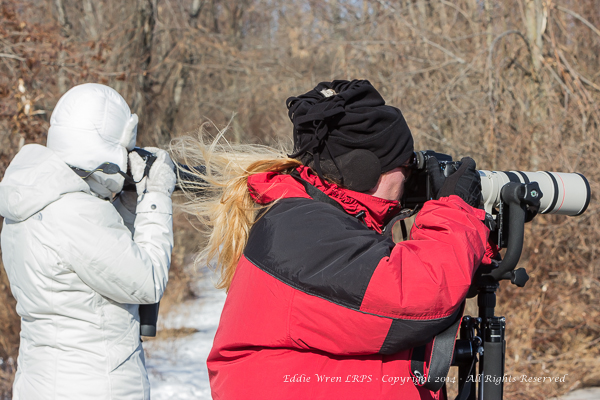
Donna and Andrea at work

Donna and Andrea at work

After the short walk through the woods to the river, it took only a few moments to pick out over 40 distant Tundra Swans, huddled down with their heads tucked in, for warmth.  A couple of them later lifted their heads and an additional swan flew in, and these two little incidents gave us a somewhat better look (see above).

Male and female Bufflehead

Male and female Bufflehead

With the vast majority of the waterbirds being well out into the Niagara River, it was inevitably longer lenses that were most useful.  However, courtesy of Andrea, I was trying out her Canon EF 70-200mm f/2.8 IS USM zoom lens and I’ve posted a few of the cropped results on this page. (Thanks, Andrea!)

Red-breasted Merganser - male

Red-breasted Merganser – male

For any birders not from this area on the US/Canadian border, it is worth adding that the Niagara River is classed as an Important Bird Area [IBA] by both countries.  Indeed, in winter, the Niagara River hosts up to 20 percent of the world population of Bonaparte’s Gulls, making it a globally significant IBA.

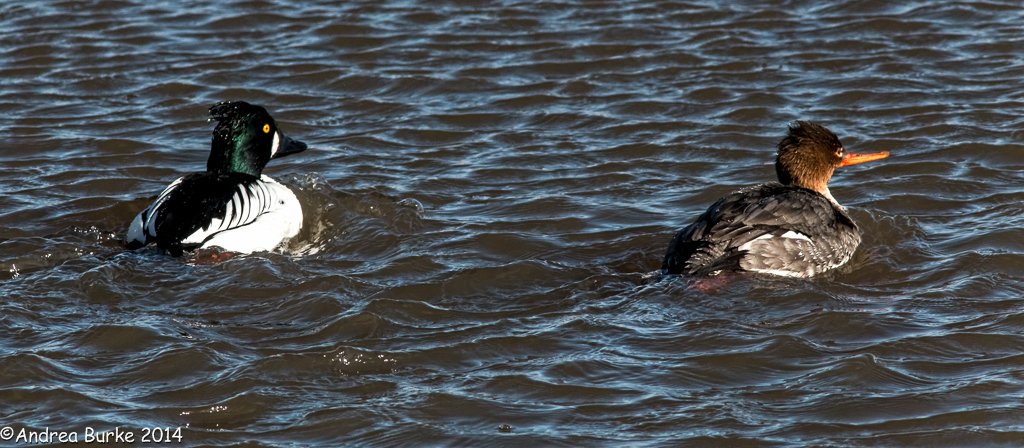
A male Common Goldeneye and a female Red-breasted Merganser

A male Common Goldeneye and a female Red-breasted Merganser

More information about the Niagara River IBA may be found at http://www.ibacanada.ca%2Fconservationplans%2Fonniagrarivercorridor.pdf

Three male Greater Scaup (Aythya marila) - a.k.a. just 'Scaup' in Britain

Three male Greater Scaup (Aythya marila) – a.k.a. just ‘Scaup’ in Britain

At the bridge over Woods Creek, right where the creek hits the Niagara, a few Greater Scaup, some Bufflehead and some Red-breasted Mergansers had come in closer to the shore, which made the challenge easier.  At this location, many of the photos here could have been taken with a pocket-sized camera (subject to cropping) — something which doesn’t happen as often as one might like.

Two Red-breasted Mergansers -- a definite female in the foreground, with an apparent first-winter bird behind.

Two Red-breasted Mergansers — a definite female in the foreground, with an apparent first-winter bird behind.

The bird species I noted during this walk were as follows (but anyone else that can add to the list, please let me know what you saw, and I’ll include them):

  • Tundra Swan (>40)
  • Canada Goose
  • Canvasback
  • Greater Scaup
  • Common Goldeneye
  • Bufflehead
  • Common Merganser
  • Red-breasted Merganser
  • Ring-billed Gull
  • Herring Gull
  • Greater Black-backed Gull
  • Rock Dove
  • American Crow
  • Black-capped Chickadee
  • Cedar Waxwing
  • American Tree Sparrow
  • Northern Cardinal

Andrea-Burke_140316-1442_ice-&-tree

Finally, on our way back to the cars, it would appear that neither Andrea nor I could resist being distracted for a few moments by what will hopefully be the last of the winter woodland sights for this year: Andrea by a water- and ice-bound dead tree and myself by one of one of my own favourite winter subjects — red  berries!

Just as the warlord in the movie 'Last of the Samurai' allegedly spent his life looking for the one perfect cherry blossom, I think I'm equally addicted to red berries! {:-)

Just as the warlord in the movie ‘Last of the Samurai’ allegedly spent his life looking for the one perfect cherry blossom, I think I’m equally addicted to red berries! {:-)

As for our Wildlife Watchers and Nature Photographers group, anyone in the WNY or South Ontario areas who might be interested in coming on some of our walks please just e-mail me on wwnp [at] eddiewren [dot] com

From the first of April until Nov/Dec, we will be out somewhere most weekends.

Eddie Wren


Basking in the Sun during Buffalo’s March 12 Blizzard!

Yes, I admit I was having fun at Buffalo’s expense.  I was very briefly in California with perfect (lucky!) timing to avoid the March snow

Heading south into the Santa Monica Mountains R.A., on the Pacific Coast Highway

Heading south into the Santa Monica Mountains R.A., on the Pacific Coast Highway

storm in WNY, and having finished my work at 2:30pm I hurried back to my hotel, swapped my suit for jeans and a T-shirt and headed south from Ventura down the Pacific Coast Highway, also known simply as “Route 1”.

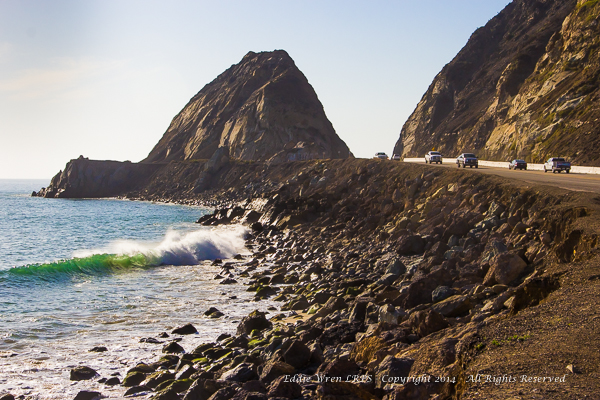
Looking southwards on the PCH, near Mugu Peak

Looking southwards on the PCH, near Mugu Peak


Retrospective of the previous photograph

Retrospective of the previous photograph

I was on my way to the beautiful hill roads in the Santa Monica mountains — an area I have been lucky enough to get to know quite well over the past few years — but it would take a better man than me to simply drive down “the PCH” without stopping to admire the views!

Two California Ground Squirrels. (The eye of the well-camouflaged, second animal is up and to the right from the eye of the front one.)

Two California Ground Squirrels. (The eye of the well-camouflaged and shaded, second animal is up and to the left from the eye of the front one.)


At one of my stops, I found and photographed a couple of California Ground Squirrels (Otospermophilus beecheyi), an interesting but skittish creature that lives in a communal burrow, but each of which allegedly has its own private entrance tunnel.

Name that bird!  It doesn't seem to be a female towhee and it's bill is to slender for it to be other species I can think of.  Does anyone know what it is, please?

Name that bird! It doesn’t seem to be a female towhee and it’s bill is to slender for it to be other species I can think of. Does anyone know what it is, please?


Nearby, I saw and photographed a small bird, in scrub, but for the life of me I can’t find anything quite like it in Sibley or my other bird books.  The nearest thing I can think of is a female towhee, but that doesn’t fit, either. Can anyone help me out with the I/D, please?

Around 5:40pm, I reached Decker Canyon Road and headed off up one of my favourite hill roads in that area.  (All of them are enjoyable but they are narrow so great care has to be taken on the many blind curves, in case someone is coming the other way.)  By that time of evening, the temperature was still in the mid-70s….. a little different to ‘back home’ in Buffalo!

The first proper 'hairpin' up Decker Canyon Road from the PCH. Further up the hill, the road follows the line of utility poles that are visible higher on the right-hand side of the photo.

The first proper ‘hairpin’ up Decker Canyon Road from the PCH. Further up the hill, the road follows the line of utility poles that are visible higher on the right-hand side of the photo.


West Seneca Oxbow Wetland Restoration, WNY

As someone who is not exactly from Western New York originally — {:-) — I had no idea that there even were any old oxbow lakes in the area, let alone one on which restoration efforts had been made, but there is and its in West Seneca.

The Buffalo Niagara Riverkeeper [BNRK] website states that “West Seneca’s oxbow wetland on Buffalo Creek is just a few miles upstream from the industrialized Buffalo River, a Great Lakes ‘Area of Concern’. As one of only three major wetlands in the lower Buffalo River watershed, it is considered a source area for future habitat and species restoration in the AOC.  Planning studies over the past 40 years have recommended that the oxbow site be protected.”

According to the  ERIE [Ecosystem Restoration through Interdisciplinary Exchange] webpage, “the restoration of the  oxbow wetland began in 2008 as part of the Buffalo River Watershed and AOC  restoration effort.  The project was led by BNRK and funded by a grant from the National Fish and Wildlife Foundation.

“In Fall 2009, six ERIE trainees became involved  in the restoration project… [and] donated over  1000 hours in fieldwork and analysis of flora, fauna, soils and groundwater.  The trainees developed a habitat restoration  and management plan for the 14-acre parcel of the oxbow. The plan used an  adaptive management framework to control invasive plant species and reintroduce  native plants to the site based on historical and nearby reference  communities. ”

To see pictures of the Oxbow and ERIE trainees working on the project (courtesy of Buffalo Niagara Riverkeeper), click here.

IfI can establish that there is public access to this site, or get us permission to visit, then this seems like a good venue for one of our ‘Wildlife Watchers & Nature Photographers’ group walks.  I’ll let you know the outcome of this.

The Financial Link between Hunting & Fishing and Sustainable Wildlife Populations in the U.S. National Wildlife Refuge System

The case for this apparently very successful approach is outlined in a press release dated March 5, 2014, as follows:

WASHINGTON, D.C. – U.S. Fish and Wildlife Service Director Dan Ashe today announced the agency will expand hunting and fishing opportunities throughout the National Wildlife Refuge System, opening up new hunting programs on six refuges and expanding existing hunting and fishing programs on another 20 refuges. The rule also modifies existing refuge-specific regulations for more than 75 additional refuges and wetland management districts.

The Service manages its hunting and fishing programs on refuges to ensure sustainable wildlife populations, while offering traditional wildlife-dependent recreation on public lands.

“For more than a century, hunters and anglers have been the backbone of conservation in this country and a driving force behind the expansion of the National Wildlife Refuge System,” said Secretary of the Interior Sally Jewell. “By providing more hunting and fishing opportunities on refuges, we are supporting a great recreational heritage passed down from generation to generation, creating economic growth in local communities and helping to ensure that conservation stays strong in America.”

Under the National Wildlife Refuge System Improvement Act of 1997, the Service can permit hunting and fishing where they are compatible with the refuge’s purpose and mission. Hunting, within specified limits, is permitted on more than 335 wildlife refuges. Fishing is permitted on more than 271 wildlife refuges.

“Hunting and fishing are time-honored ways to enjoy the outdoors and teach people to value nature,” said Director Ashe. “Our National Wildlife Refuge System has millions of acres of public land and water to provide quality hunting and fishing experiences. We hope these expanded hunting and fishing programs will allow more Americans to experience this connection with nature.”

Hunting, fishing and other outdoor activities on national wildlife refuges help stimulate the economy and generate funding for wildlife conservation. Banking on Nature, a Service report released in November, showed refuges pumped $2.4 billion into the economy. Across the country, refuges returned an average $4.87 in total economic output for every $1 appropriated in Fiscal Year 2011.

Other wildlife-dependent recreation on national wildlife refuges includes wildlife photography, environmental education, wildlife observation and interpretation.

###

The press release also contains a list of the refuges affected by the above policy change, one of which — Shawangunk Grasslands National Wildlife Refuge — is here in New York.

How the Reintroduction of Wolves Helped Save Yellowstone National Park

This is one of a series of four-minute video gems from the BBC, under the heading of ‘The Power of Nature’

“Wolves had been absent from Yellowstone National Park for more than 70 years when they were reintroduced in the 1990s – and their return had some surprising benefits….”

Read more and view: How Wolves Saved Yellowstone National Park (sponsored by Nikon cameras)