Category Archives: North America (news)

Nature-related news from North America

More Disease Problems for Bees in the US and Worldwide

An article published today in Britain, by the BBC, under the heading of ‘Bumblebees infected with honeybee diseases’, might not seem to be cause for alarm among nature lovers in America, but there can be no doubt that it is.

Honey Bee on Birds-foot-trefoil. Copyright 2013, Eddie Wren

Honey Bee on Birds-foot-trefoil. Copyright 2013, Eddie Wren

Given that bees are a massive factor in the viability not only of the wild flowers that we all enjoy but also of many important food crops, the rise of Deformed Wing Virus [DWV] and of the microsporidian ‘Nosema ceranae‘ should be of concern to anyone who has an interest in the health of our environment, and not least to bee keepers, whose livelihoods are once again being threatened.

When I read the above article, I did a search for these two problems in the USA, and sure enough I found this this report from the American Society for Microbiology, about DWV here in the States.

As for the ‘Nosema ceranae‘, Wikipedia has plenty to tell us about the spread of this pathogen, not only in the Americas but worldwide.

__________________________________________

Fox News in the USA has now run a version of this story, here.

Bobcat sightings around Western New York show range map is in need of revision

This article, by Gerry Rising, was published in the Buffalo News at the end of December, 2013, but it is of more than enough interest for us to give the URL again, here:

http://www.buffalonews.com/opinion/nature-science/nature-watch-bobcat-sightings-around-western-new-york-show-range-map-is-in-need-of-revision-20131229


How salmon help keep a huge, Canadian rainforest thriving

Canada’s Great Bear Rainforest is the largest temperate rainforest in the world. This huge and pristine wilderness depends on an unlikely source for its long-term survival – the salmon which spawn in its rivers and creeks….

In the linked video (see below), ecological economist Pavan Sukhdev, The Nature Conservancy’s lead scientist Dr M Sanjayan and camerawoman Sophie Darlington talk about the salmon’s unsung role in fertilising the forest. The bears who feast on the spawning salmon don’t eat on the river – they drag the carcasses far into the forest. The remains of the salmon contain vast quantities of nitrogen that plants need to grow. Eighty percent of the nitrogen in the forest’s trees comes from the salmon. In other words, these ocean dwellers are crucial for the forest’s long-term survival.

Watch the video, from the BBC, at: http://www.bbc.com/future/story/20140218-salmon-fertilising-the-forests

Links to Wildlife-related Organizations and Websites in the Rest of the USA

Back to the main LINKS page

____________________________

Alaska Fish and Wildlife News

Audubon Society (National)

Audubon Society – Find Your Local Chapter

BugGuide.net – USA and Canada

Butterflies and Moths of North America [BaMoNA]

Lady Bird Johnson Wildflower Center (TX)

National Wildlife Federation

Nature Conservancy

Nature Conservancy Newsroom

Odonata Central – Dragonflies & Damselflies

Spiders in the USA (spiderzrule.com)

U.S. Fish & Wildlife Service – News

U.S. Fish & Wildlife Services – ‘Open Spaces Blog’

Wildflower Viewing Areas – U.S. Forest Service

Wildlife Society – News

 _________________________

Please feel free to add a comment, below, recommending other URLs that should be added to this page

Links to Wildlife-related Organizations and Websites in New York State

Back to the main LINKS page

WNY

Buffalo & Erie County Botanical Gardens

Buffalo Audubon Society

Buffalo Ornithological Society

Nature Conservancy – Central & Western New York

NYS Department of Environmental Conservation – Western New York

Rochester Area Mycological Association – RAMA

Roger Tory Peterson Institute of Natural History (Jamestown)

Sierra Club – Niagara Group

Tifft Urban Nature Preserve, Buffalo


OTHER

Audubon – New York State (with Chapter links)

Audubon – New York State – Calendar of Events

Cornell Laboratory of Ornithology – All About Birds

NYOG – New York Odonate Group (Yahoo groups)


Please feel free to add a comment below, recommending additional websites that should be included on this list.

Links to Wildlife-related Blogs in the Rest of the USA

Back to the main LINKS page

____________________________

INDIVIDUALS

Dragonflies and Damselflies of the N.W. and Beyond (Jim Johnson)

Feathered Photography (Ron Dudley, Utah)

Insect Photography (Alex Wild)

Jerry Liguori’s Raptor Blog

Meadowlands Nature Blog (Jim Wright, NJ)

Ohio Nature Blog (Tom Arbour)

ORGANIZATIONS

Conservancy Talk    Nature Conservancy staff share their voices on everything from the latest conservation issues to living green.
.
Cool Green Science Nature Conservancy science: 550 scientists helping you get smart about nature.
.
Nature Rocks   Aiming to inspire and empower families to play and explore in nature for happier, healthier and smarter kids.

 ______________________________________________

Please feel free to post comments below, with the URLs for other good wildlife blog sites.  (All we ask is that they be posted on the correct page: WNY, USA or Worldwide, please.)

Snowy Owls in Western New York, January 2014

On 26 January, 2014, Gerry Rising had an article published in the Buffalo News in which he wrote that, remarkably, he has received over 100 reports of snowy owls in the Western New York region, this winter.

Snowy Owl. Copyright 2013, Andrea Burke

Snowy Owl. Copyright 2013, Andrea Burke

As one might expect, this hasn’t been a result of all the snowy owls in the arctic agreeing that they wanted to come and see Niagara Falls during their winter vacation, it’s just that far more owls than usual have come south this year and it would appear that everywhere is getting higher numbers of these beautiful visitors than is usually the case.

Snowy Owl. Copyright 2014, Jennifer Grande

Snowy Owl. Copyright 2014, Jennifer Grande

The increased number of owls, this winter, is the result of a periodic surge that happens every few years in the numbers of lemmings in the arctic, and this took place last summer.  It is a simple equation: more lemmings means more young owls getting enough to eat and therefore surviving.  This results in an ‘irruption’ in which the species is seen across a much larger winter migration area than is usually the case.  The downside of such surges in numbers is that in the coming few months, when the owls get back to the arctic, there inevitably will be fewer lemmings and the breeding success of the owls will fall once more, in line with that situation.

Snowy Owl. Copyright 2013, Andrea Burke

Snowy Owl. Copyright 2013, Andrea Burke

In the book Owls of America, by Frances Backhouse, there is a very interesting map showing the typical winter distribution of snowies.  Only two regions in the USA are marked as getting some of the owls every winter.  One of these areas, as keen birders in this area know, is New England and New York.  The second is the Dakotas and Montana region.
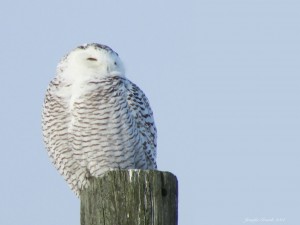
Snowy Owl. Copyright 2014, Jennifer Grande

Snowy Owl. Copyright 2014, Jennifer Grande

By comparison, the breeding distribution – which is also shown on the map – is much more limited than I had anticipated.  For example, only the areas near the north west and north east coasts of Alaska is marked. I had wrongly assumed for example that most, if not all of Alaska would be part of their breeding range, but that is not the case.  Similarly, only the far-northern coastal area of Canada supports breeding, not the entire tundra zone.  Even in Greenland, according to the map – and just like Alaska – only the areas near the north west and north east coasts are in the breeding range.

Snowy Owl. Copyright 2014, Jennifer Grande.

Snowy Owl. Copyright 2014, Jennifer Grande.

Excerpt from ‘Owls of America’:     “Snowy owl numbers fluctuate dramatically.  Reproductive highs and lows [as stated above] are closely tied to lemming population peaks and crashes.  Long-term population trends in North America are not known.  Recent research showing some movement of snowy owls between Alaska and Russia suggests that conservation efforts should be co-ordinated internationally.”

One other interesting thing about snowies is that unlike most other species of owl in the world, males and females have different plumage and can be told apart.  Old males can be almost pure white, whereas females are moderately to heavily barred with black, and juveniles have the darkest markings.

Snowy Owl. Copyright 2013, Andrea Burke

Snowy Owl. Copyright 2013, Andrea Burke

Personally speaking, I have had back problems throughout this winter, and although the precise cause is now known and a cure is in sight, this has meant that I have been immobile and have not been able to go and see the owls.  I believe the appropriate, exasperated expression is: “Grrrrr!”

The reason I have posted this article is to accompany photographs taken during the past few weeks by members of our Wildlife Watchers and Photographers (WNY) group.  I hope you all enjoy the pictures as much as I have.  (And any members who have not yet submitted photos of “their” snowies, please do so and I will add them to a gallery on this page.)

Eddie Wren

___________________________________________

 Anyone in the Western New York region who is interested in joining the Wildlife Watchers and Photographers (WNY) group, please e-mail the owner of this blog and introduce yourself.

___________________________________________


Keywords: snowy owl, Bubo scandiacus, Andrea Burke, Jennifer Grande, Eddie Wren, Western New York, WNY, birds, Buffalo News, Gerry Rising, Frances Backhouse, Owls of America, migration, plumage, range, winter, arctic, lemmings, birding, wildlife, nature, USA